Systems Explained
The fast, safe way to charge your house batteries back — without idling your engine for hours.
The 30-Second Answer
A secondary alternator is the fastest, safest way to recharge your house batteries. It charges your system back at a far higher rate than your van does on its own — and without forcing you to idle your engine for hours, which is hard on the motor and something we’ve watched people destroy engines doing. Does everyone need one? No. It’s built for the customer who uses a lot of power — especially air conditioning — and doesn’t want to think about charging back. If you drive somewhere new most days, your normal charging probably keeps up. If you like to park in one spot for a week and run the AC, this is what makes that possible. +$8,000 over your power tier.
What It Actually Does
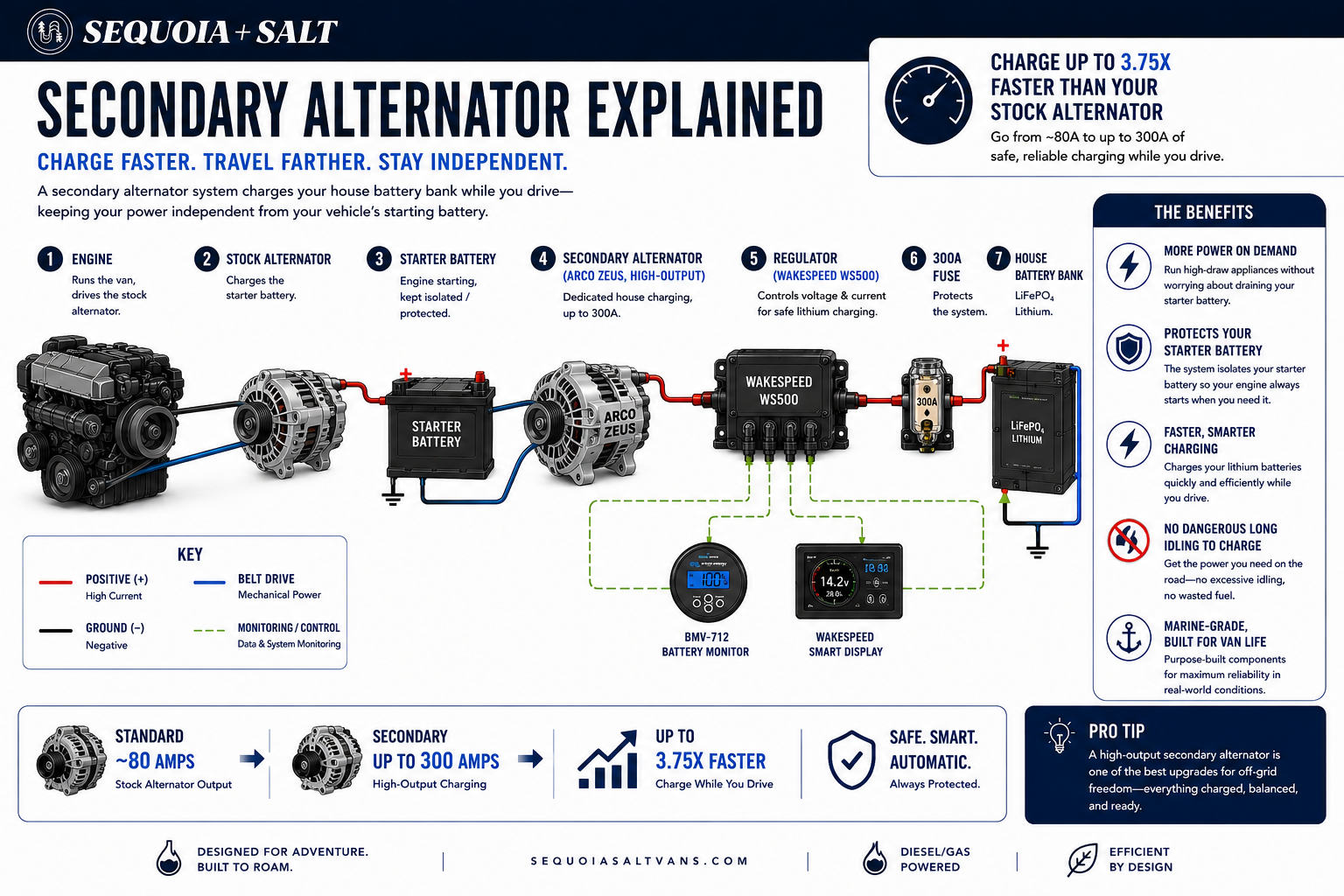
Your van already has an alternator — the one that charges your starter battery and runs the vehicle. A secondary alternator is a second, high-output unit dedicated to charging your house batteries: the cabin system that runs your lights, fridge, inverter, and AC. The point of it is simple — speed and safety of charge-back.
The Mistake Nobody Warns You About
When your house batteries get low and you’re parked off-grid, the tempting move is to start the van and let it idle to charge the system back. Don’t. Idling for hours runs the engine at low RPM for long stretches — it’s bad for the motor, and we’ve seen people blow their engines doing exactly this. An engine isn’t designed to sit and idle as a generator.
A secondary alternator solves this. It’s engineered to put out serious power at the RPMs your engine actually likes — the ARCO Zeus units are optimized for output even at idle speeds and run 8–20% cooler than standard alternators thanks to dual cooling fans, an exterior rectifier, and heat-shedding coatings. So you get a fast charge without cooking your engine. It’s the safe version of the thing you were tempted to do the dangerous way.
The Amp Math
This is where it gets real. Here are actual numbers from our systems — what you spend, and what you get back.
Our AC units pull about 20 amps/hr on eco mode, and up to 45 amps/hr on high (AC gets less efficient the hotter it is outside — the harder it works, the more it pulls). Our power systems start at 460 amp-hours and can expand to 2–3× that.
Charging normally as you drive, our systems put roughly 60–80 amps/hr back into the batteries. With a secondary alternator, you can push charge-back up to around 300 amps/hr — roughly four to five times faster.
Now do the math on a real trip. A couple is out for the weekend, it’s hot and muggy, and it rains the whole time — so the AC runs well beyond sleeping mode, say 20 hours a day at 20 amps/hr. That’s 400 amp-hours a day off a 460Ah system: nearly empty by nightfall. If they’re driving five hours to the next spot, no problem — normal charging tops them up on the road. But if they want to stay put for a few days running that AC? That’s where the secondary alternator earns its keep: a short engine run puts the system back to full and buys them another full day.
System Diagram
Trace it from the engine, through the stock alternator and starter battery, out to the high-output ARCO Zeus and its regulator, and into the LiFePO₄ house bank. This is the exact second charging circuit we wire into a Scout or Loft that gets the secondary-alternator upgrade.
Why Marine-Grade Matters
We install the ARCO Zeus — a marine-grade unit, the same hardware trusted on boats that run air conditioning off their batteries all night at sea. ARCO has been making this stuff in the USA for 60 years; the units are SAE J1171 certified and pair with a lithium-aware Bluetooth regulator that integrates cleanly with the Victron systems we build. That means precise, battery-safe charging — not just brute force. For a system you’re going to depend on in the middle of nowhere, that reliability is the whole point.
Decision Framework
There’s no universal right answer — there’s the right answer for your trip. We’d rather talk you out of $8,000 you don’t need than sell you power you’ll never use.
Where solar fits: our systems start with 400 watts of solar, which is strong — it’ll maintain your refrigerator and your inverter’s baseline draw indefinitely. But solar isn’t designed to fully power nonstop air conditioning. If you plan to run AC hard while parked, solar alone won’t cover it. That’s the gap the secondary alternator fills.
What It Costs at Sequoia + Salt
The secondary alternator adds $8,000 to whichever power tier you choose. That includes the marine-grade ARCO Zeus high-output alternator, a custom mounting bracket fabricated for your specific van platform, dedicated belt drive, the lithium-aware Bluetooth regulator, wiring to your Victron battery bank, and installation backed by our warranty. It stacks with any power tier — and earns its keep most on the larger battery banks. Not sure whether your travel style needs it? That’s a five-minute conversation on a build call, based on how you actually plan to travel, not a spec sheet.
See real numbers for your Scout or Loft in about two minutes — no salesperson, no email required.
