Honest Buyer's Guide
Why most mainstream Class B campers are built like cheap housing flips — and what it costs you in year four. A working builder's honest comparison of marine-grade custom builds vs. the mainstream RV market.
 Mercedes
The Hook
Some houses are works of art. Real craftsmen, real materials, decades of know-how — the kind of place where the floors are still tight in year 30 and the cabinets close like they did the day they were hung.
Then there are the flips.
You've seen them. They look amazing for the showing. Fresh paint. Modern fixtures. Trendy laminate floors. The Instagram-ready kitchen with white shaker cabinets and gold pulls. You walk through and think "this looks beautiful."
You move in, and within six months you find what's underneath. Particle-board cabinets wrapped in peeling vinyl. "Hardwood" laminate over a subfloor someone screwed down with the wrong screws. The cheapest possible PEX plumbing already leaking at every connection. Every system in the house was chosen on one criterion: how cheaply can we get it in here and still close the deal.
The contractor bought the worst house on the block for pennies, spent pennies dressing it up, and sold it to you for top dollar. They were optimizing for one thing — speed of resale at maximum margin. You inherited the consequences.
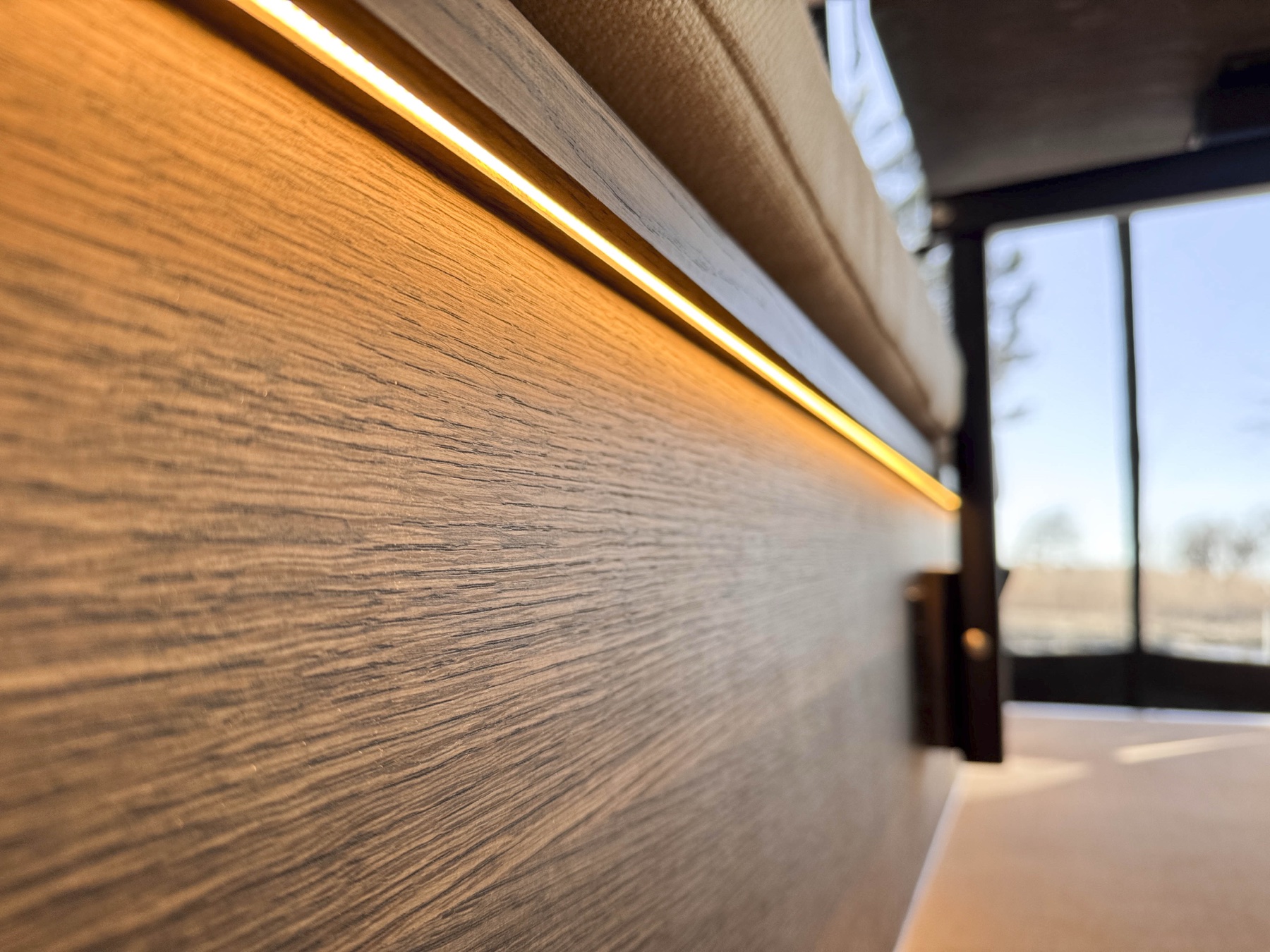
They look stunning at the Hershey RV Show. Residential laminate countertops, LED accent lighting, upholstered captain's chairs, touchscreen panels. The dealer walks you through a $200,000 unit and it photographs beautifully.
Heading to the Hershey RV Show in September or the Tampa RV SuperShow in January? Talk to us before you sign anything. The mainstream RV market is full of beautiful vans, aggressive sales tactics, and "today only" incentives — and most buyers don't know what to look for under the surface.
What you don't see is what's underneath: MDF cabinet boxes that swell from a single spilled glass of water. Particle-board subfloors that fail when they get wet — and they will get wet. AGM batteries that die at year three. Residential 110V appliances chosen because they're cheap, not because they're efficient. Vinyl wrap edgebanding that peels at every door corner. Hardware from whoever bid lowest that quarter. Wiring sized for the bare minimum.
You bought it because it looked nice. You didn't ask what it was made of. You didn't ask what the cabinets would look like at year four after three winters in Colorado and one August in Baja.
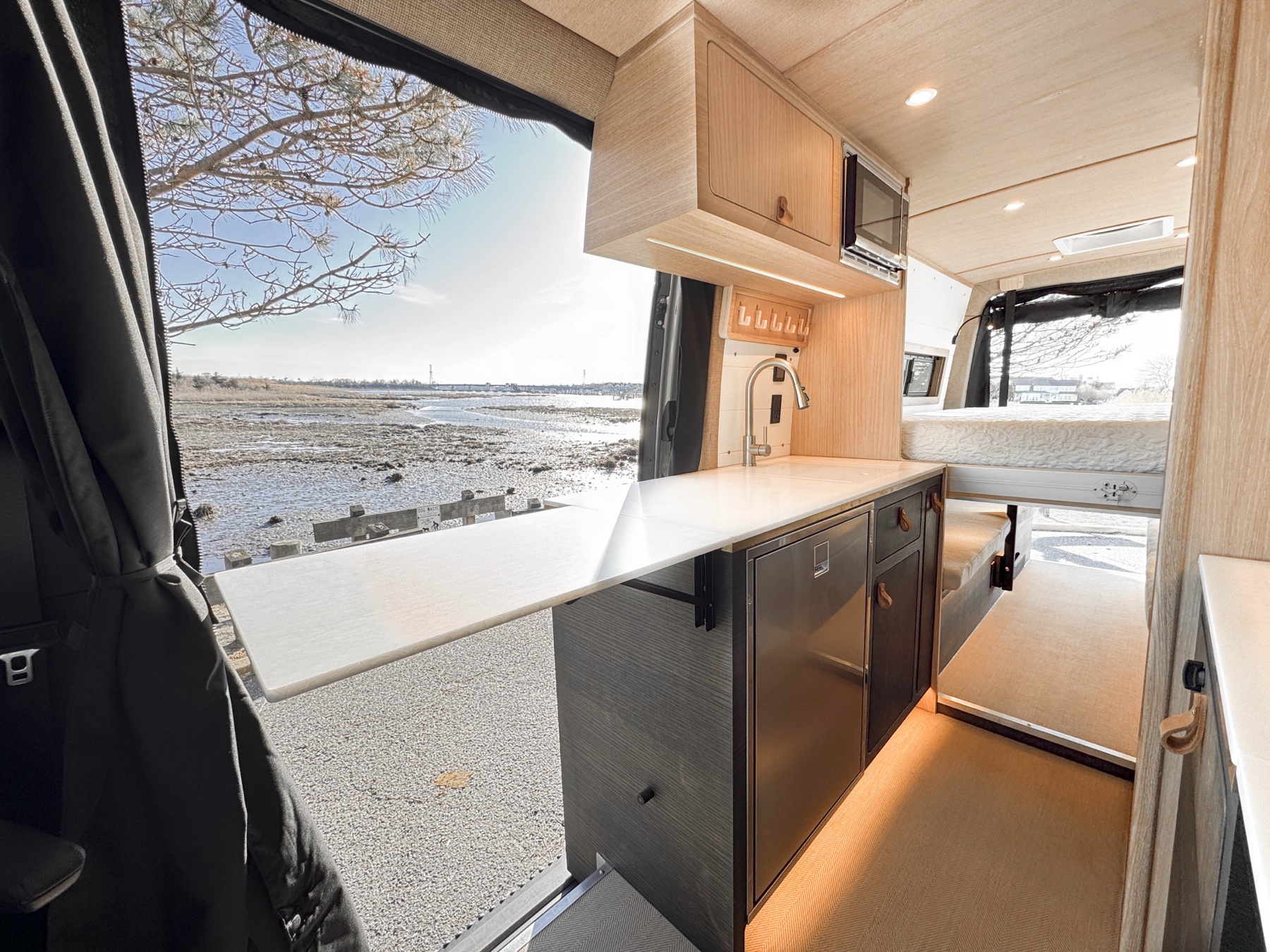
This is the core difference between Sequoia + Salt and the mainstream Class B market: we don't build flips. We build campers like boats — because that's what a van actually has to survive.
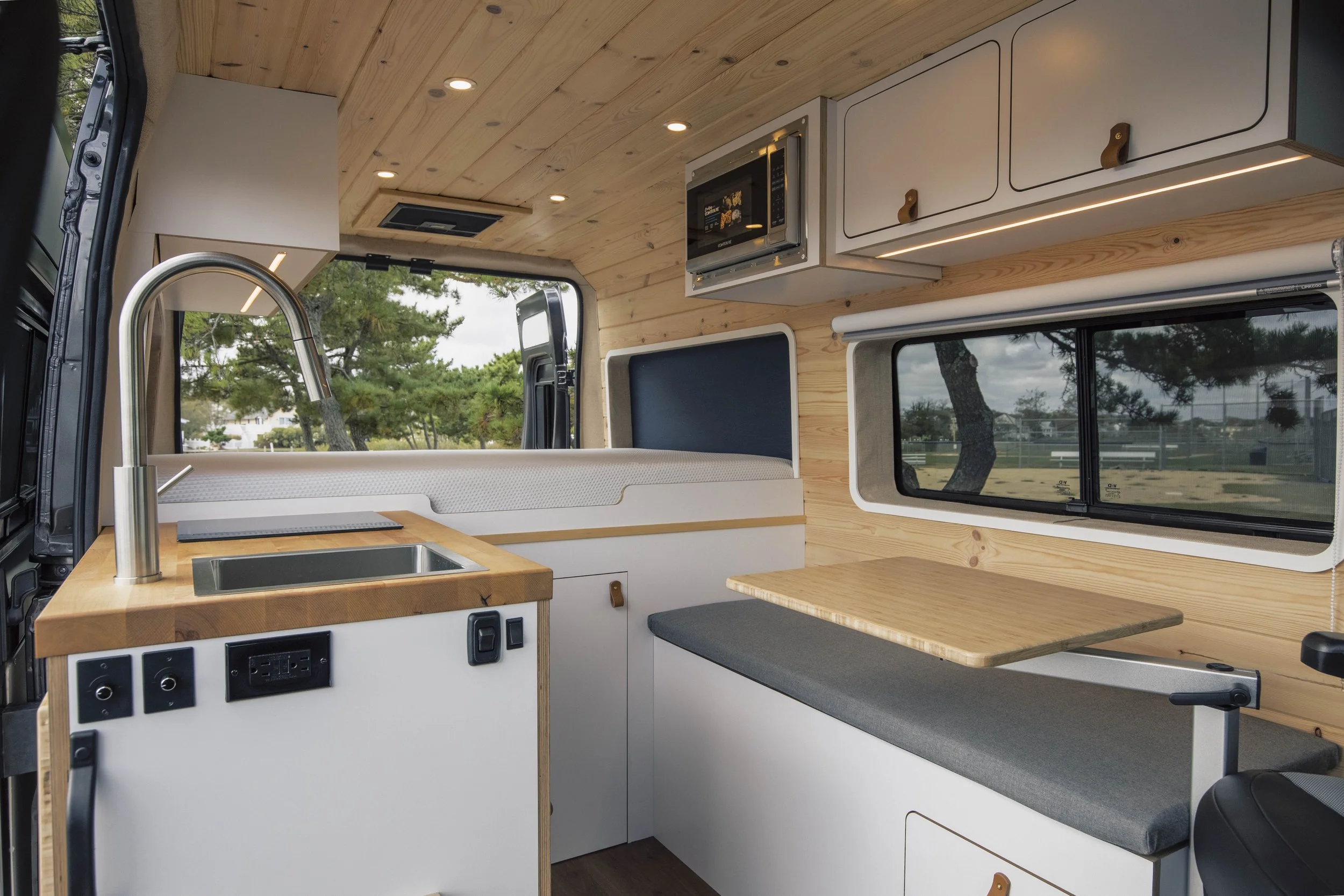
Build Philosophy
A van vibrates, pitches, and rolls every day it's in use. It heats to 130°F in the desert and drops below freezing in the mountains. The roof flexes. The walls move. Things get spilled. Wet dogs jump in. Sandy feet track in. Snow gets tracked in. It bakes parked at a trailhead for a week, then runs 800 miles overnight.
A house doesn't do any of that. A house sits there.
A boat is the opposite. Always rocking. Always wet. Always exposed to UV, salt, and temperature swings. So boats are built with marine-grade materials — fiberglass composite subfloors, waterproof wall paneling, marine wiring, weatherproof everything — because the alternative is the boat falls apart in a year.
A camper van lives a life much closer to a boat's than a house's. So we build campers like boats. Once you accept that, every other choice on the van follows.
What "Built Like a Boat" Means
Most buyers never see this material list, because most builders don't want you to compare. Here is exactly what's inside a Sequoia + Salt that isn't inside a mainstream Class B.
Mainstream Class B subfloors are typically plywood or particle board. Both fail when wet, both rot over time.
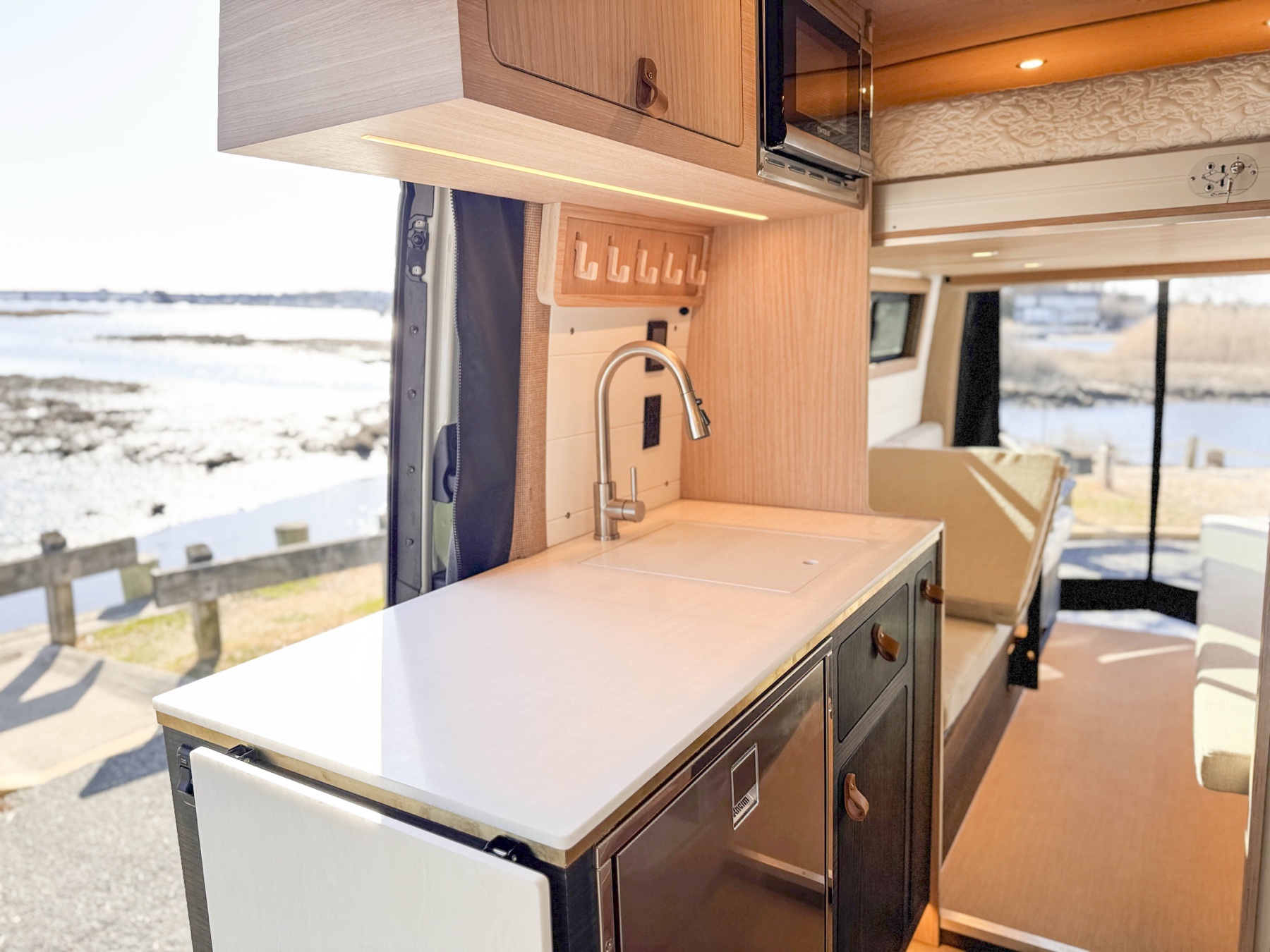
Our subfloors are Coosa board — a fiberglass-reinforced composite that's completely waterproof, exceptionally strong, and won't rot, swell, or delaminate. Ever. It's the same material Viking Yachts (built in New Jersey) uses in their high-end sport-fishing vessels. Good enough for a $4M offshore yacht, good enough for a van that's going to see snow and mud.
The shiplap-look interior walls in our vans are Starboard — marine-grade waterproof material used on yacht decks and high-end marine interiors. It doesn't absorb moisture. It doesn't warp. It doesn't grow mold. It cleans with soap and water. Mainstream interior walls are typically vinyl-skinned MDF that delaminates at the corners within a few years.
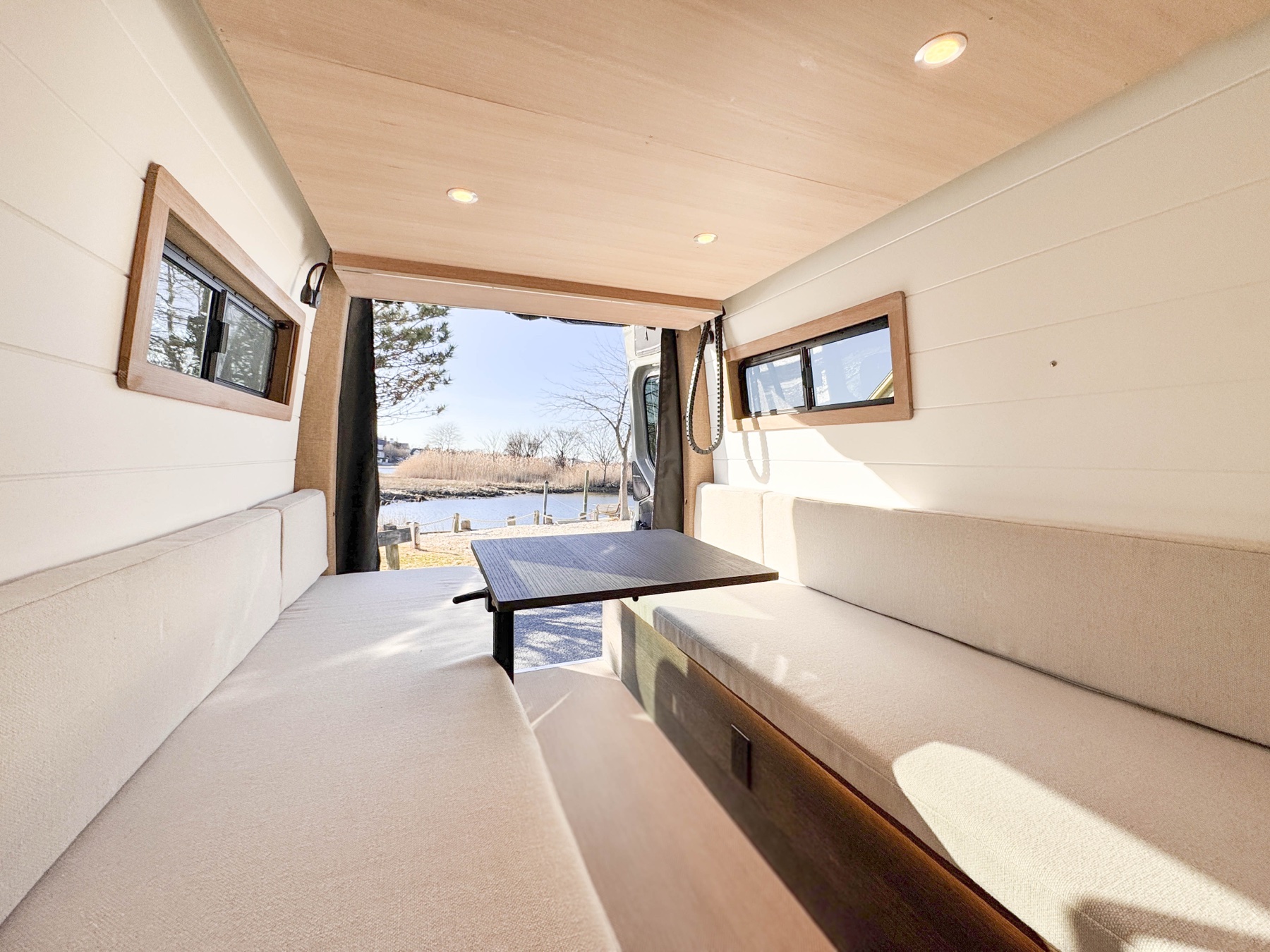
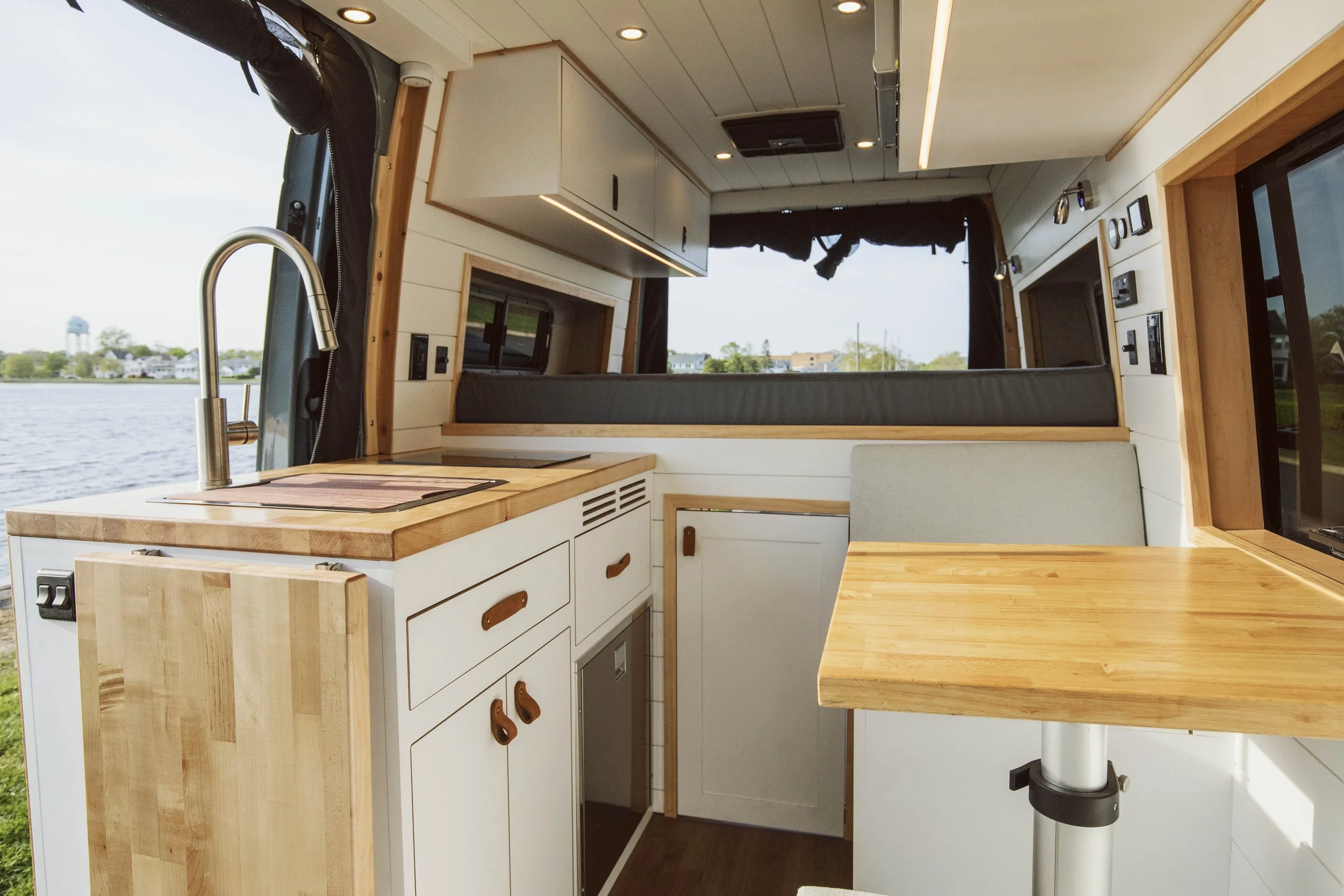
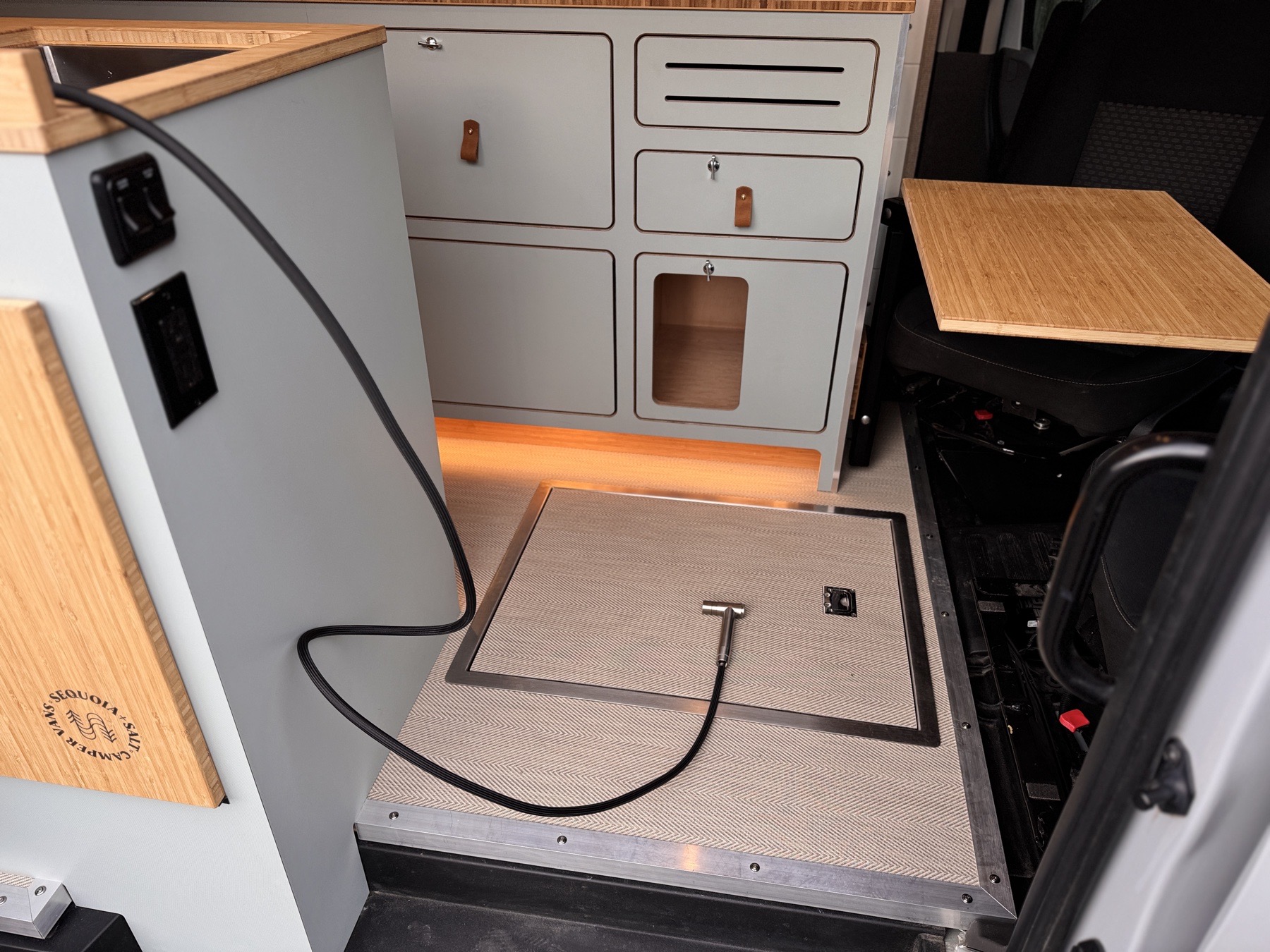
Our floors use Lonseal or 2tec2 — flooring used in commercial aviation and high-end marine. Built to survive thousands of passengers per week for a decade. Mainstream Class B floors are residential vinyl plank — the same stuff you'd put in a kitchen — which shows wear at the door and bed area within 18 months.
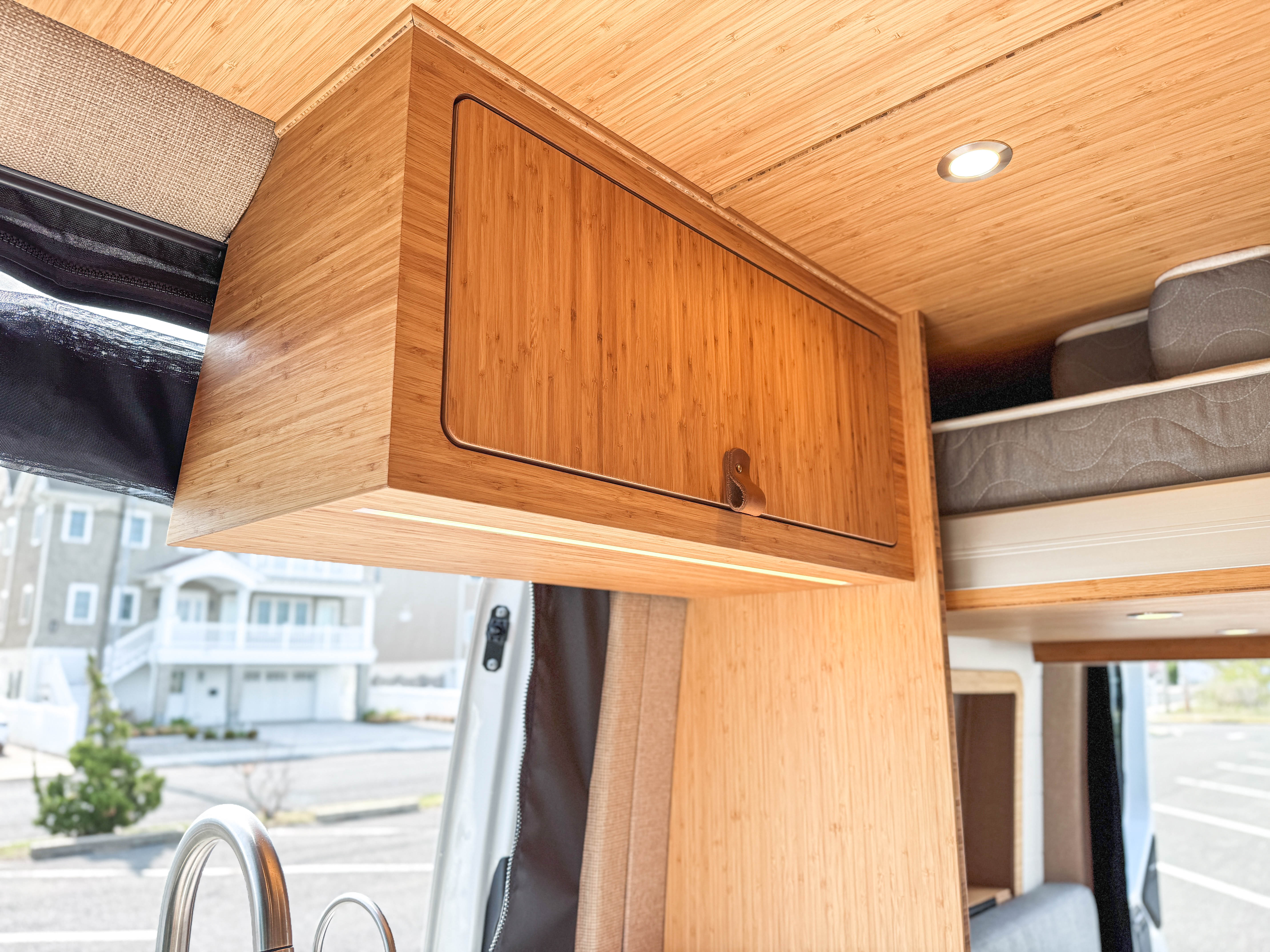
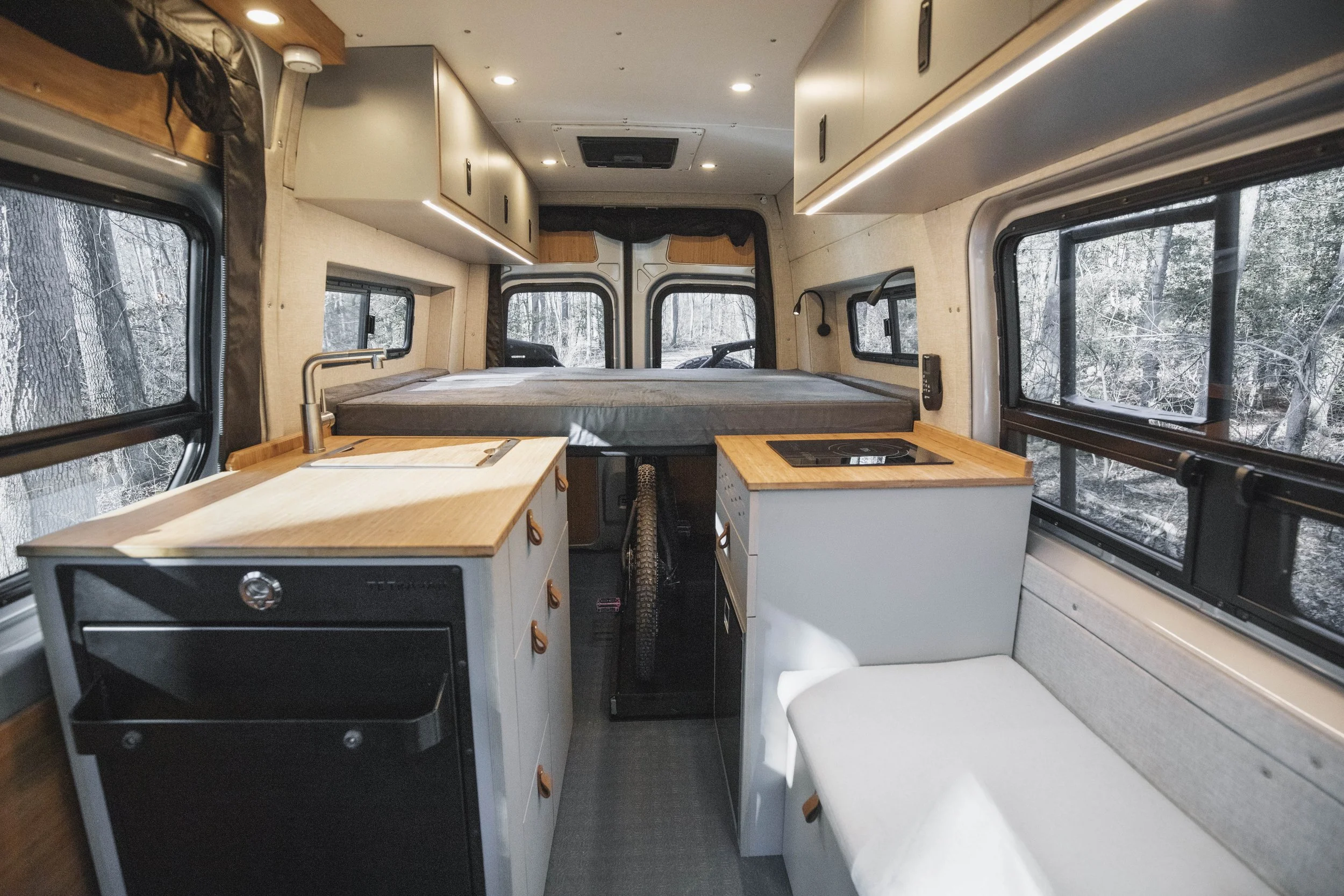
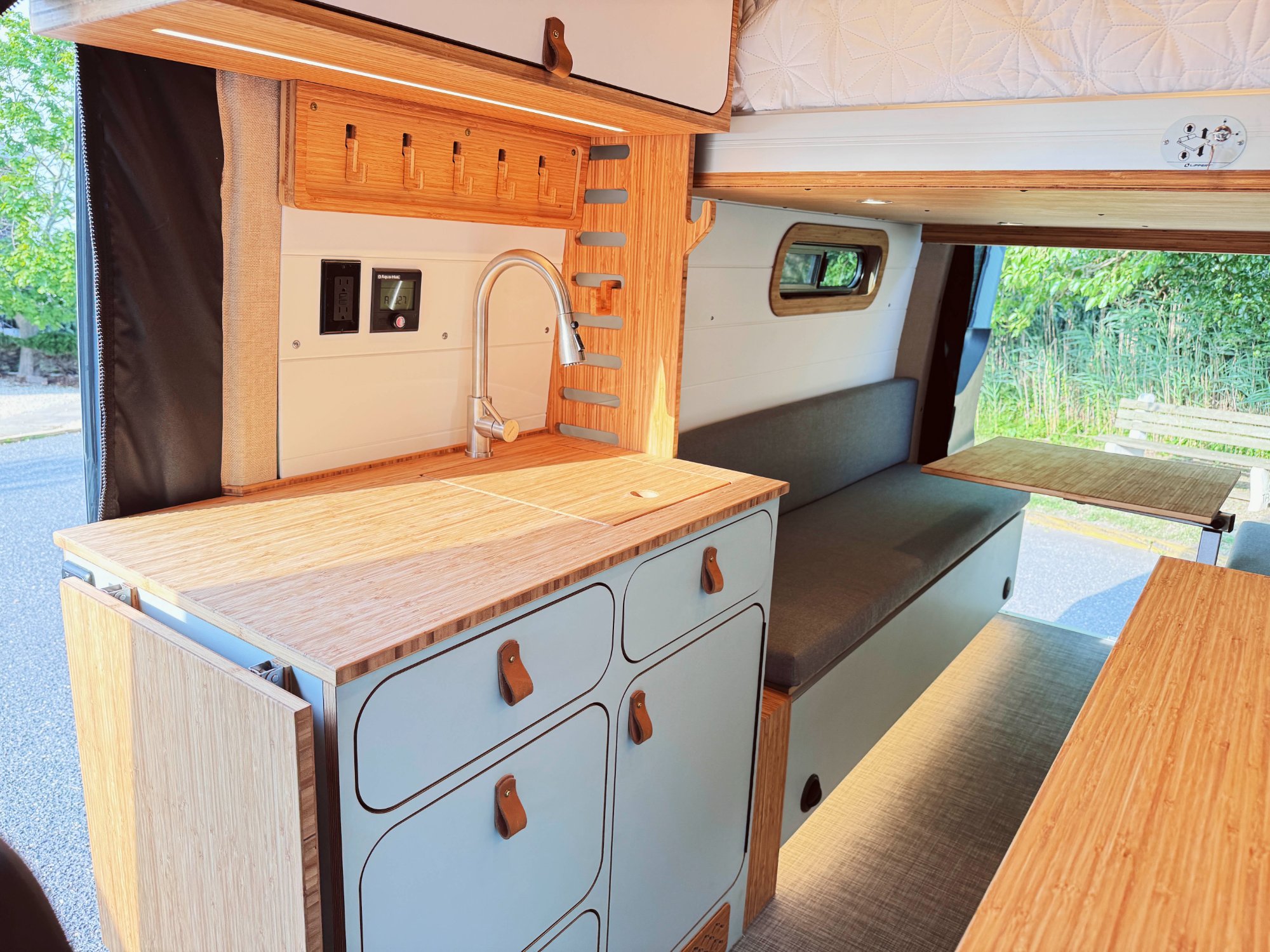
Our cabinets are built from Baltic birch plywood, multiply, and lightweight poplar. Baltic birch handles high-stress areas (door frames, drawer boxes). Multiply gives clean paintable surfaces. Lightweight poplar keeps weight down on non-structural panels. Every cabinet uses overlay face construction — doors and drawer faces sit proud of the cabinet box for a cleaner residential look that's harder to build but significantly more durable.
Every drawer slide and hinge is soft-close and lockable. Choose from 20 standard hardware options to dial in the look.
Mainstream Class B cabinets are mostly MDF with thin vinyl wrap. MDF is compressed sawdust held with glue. Add water and it swells. Add vibration over years and it loosens at every joint. By year five, $200K production-van cabinets often look worse than the cabinets in your home kitchen.
Our cabinets aren't engineered like the cabinets in your house — they're engineered for the duration of your vehicle.
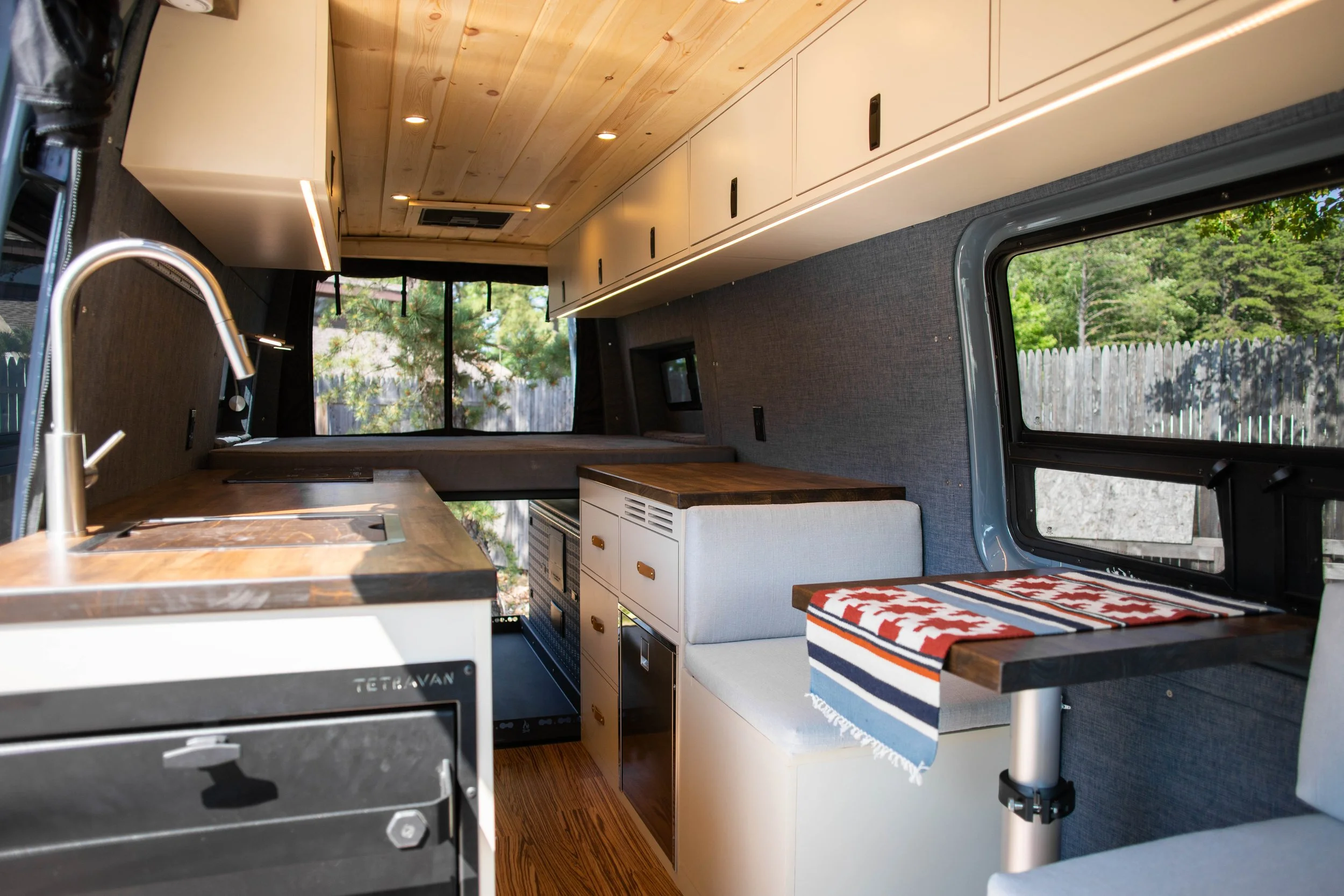
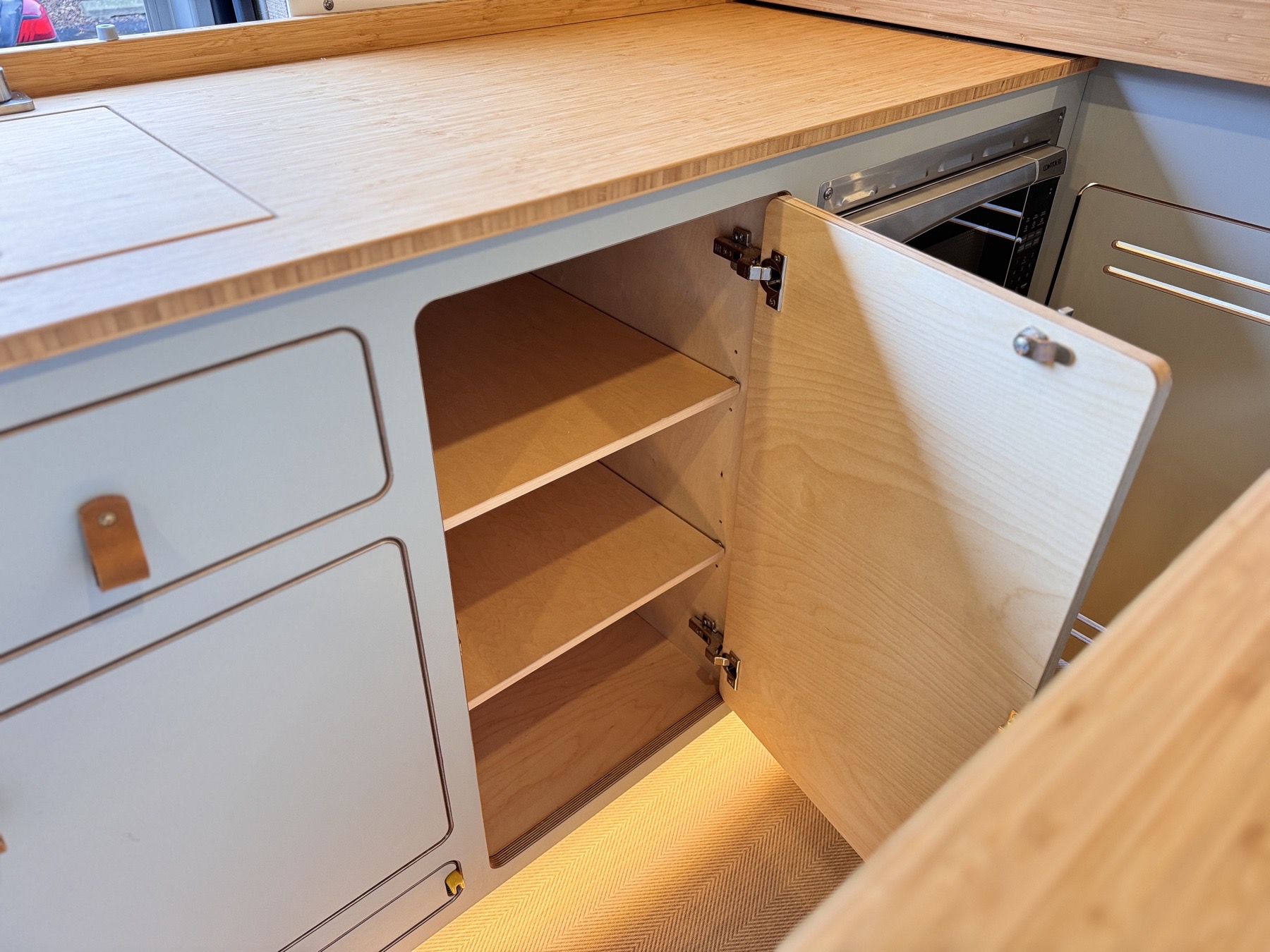
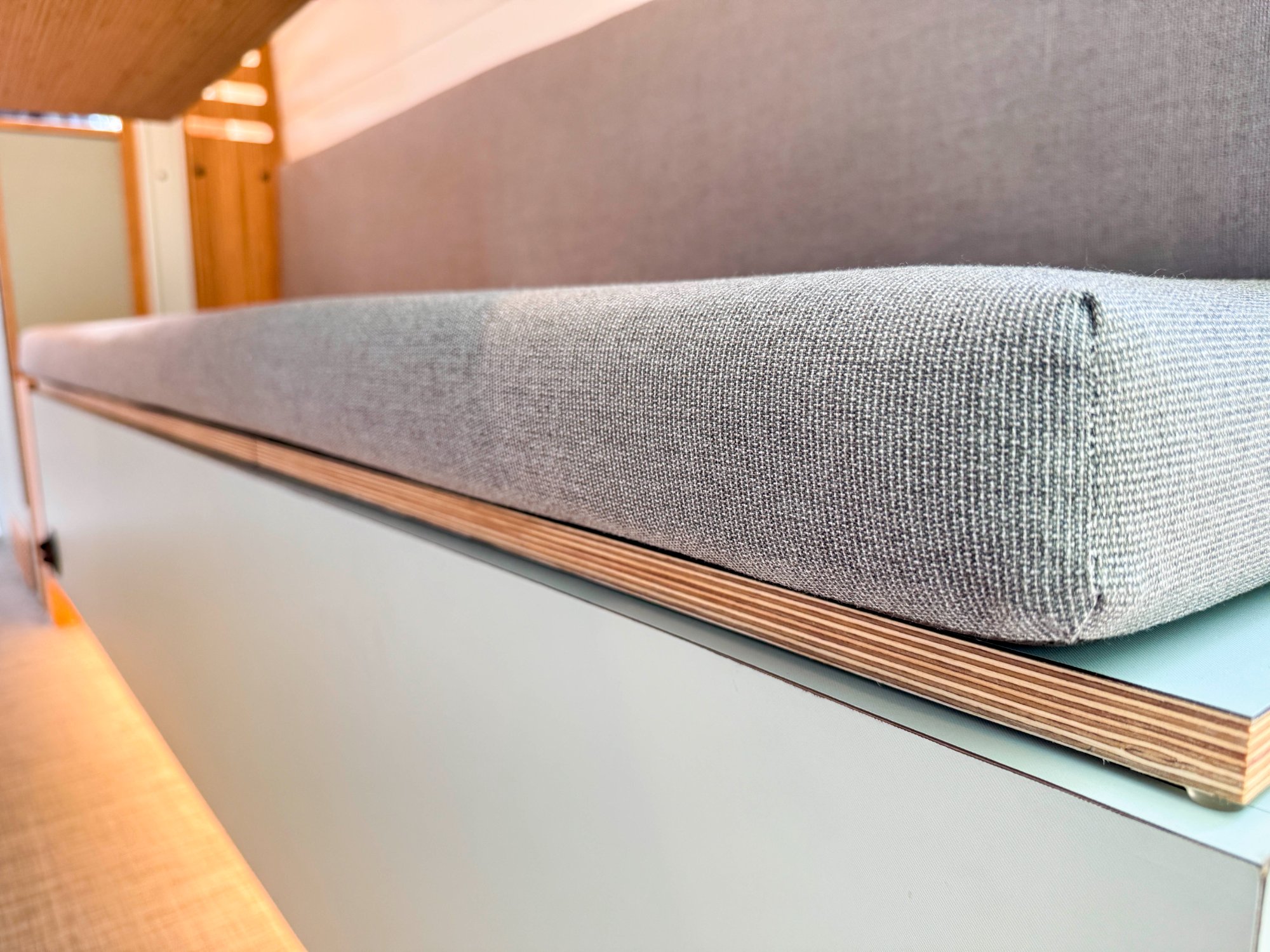
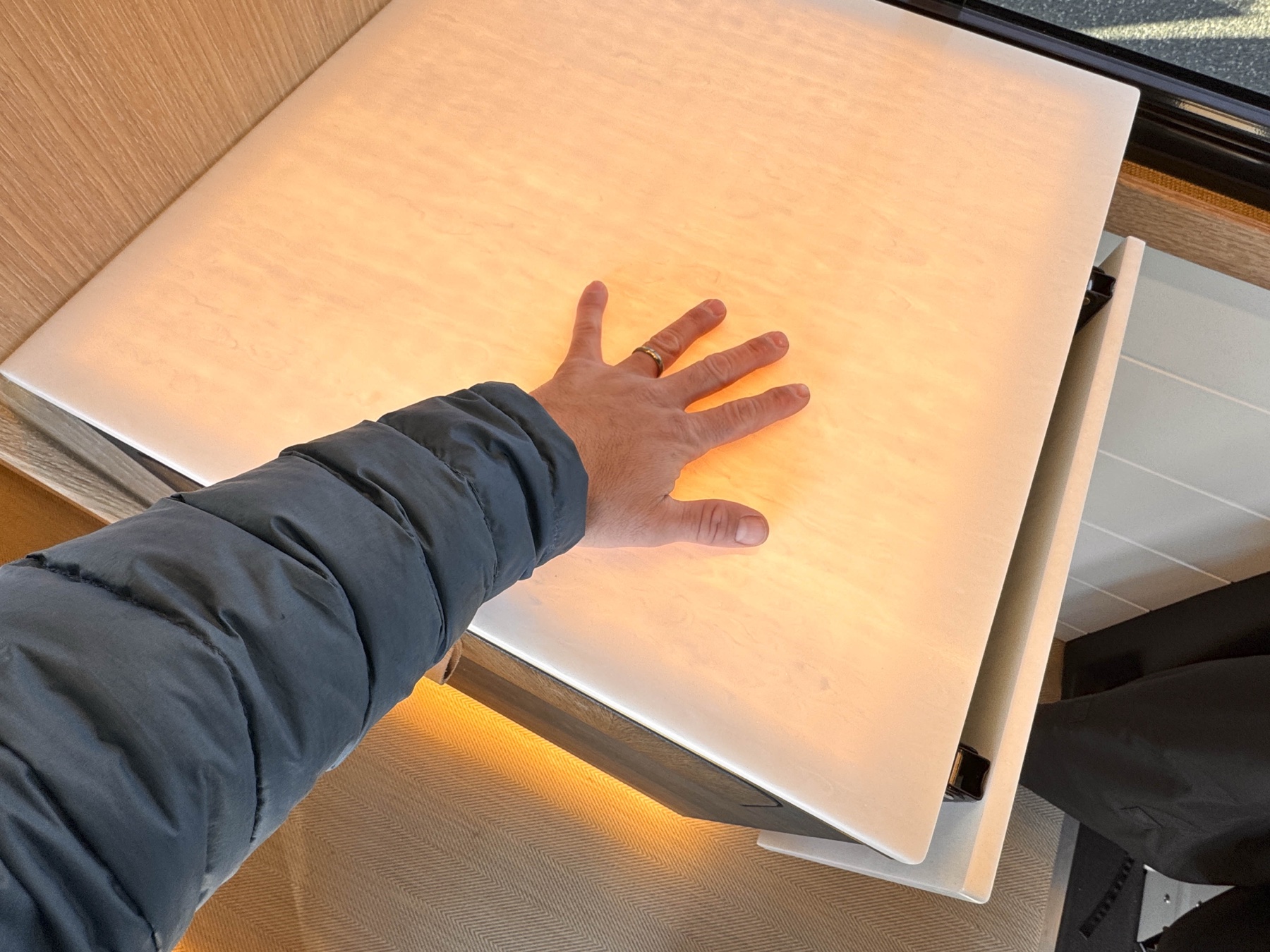
Every laminate surface in our van is hard-shell exterior-grade laminate — drop a pan, no dent. Scrub with a stiff brush, no scratch. 90 standard laminates + 103 premium laminates for almost 200 swatch choices total. Roughly 100 upholstery options for cushions, headliners, and soft goods, all selected for durability and cleanability — not just showroom photos.
Mainstream Class B countertops are typically a residential laminate or thin solid-surface veneer over particle board substrate that scratches and can't be repaired.
The Long View
A mainstream Class B at five years of moderate use shows it. Cabinet doors don't sit flush. Drawer hardware starts to fail. Laminate chips at high-touch areas. Countertops have stains. The subfloor feels soft near the door. AGM batteries are at end-of-life and the lithium retrofit you skipped is now four times the cost.
A Sequoia + Salt at five years of the same use looks like it did the day it left the shop. Cabinet doors close right. Laminate is unmarked. Coosa subfloor is exactly as it was. Starboard walls don't show wear. The Victron power system has been refilling itself daily with no degradation.
By year 10, the mainstream van has been to a dealer multiple times. The owner has either invested significant money refurbishing it or accepted it as a "well-loved" RV. The Sequoia + Salt looks like a five-year-old van that's been cared for.
By year 15, many mainstream Class Bs aren't in regular service anymore. Materials have given out. Systems have failed beyond economical repair. A Sequoia + Salt at year 15 should still be a desirable, fully-usable van. This is what you're actually buying when you buy from us: a 15-year vehicle, not a 5-year one.
A note: this assumes reasonable care. Drive it off rock-crawling cliffs or abuse the systems and you can break anything. We're talking about hard use, not abuse.
Systems Built to Match
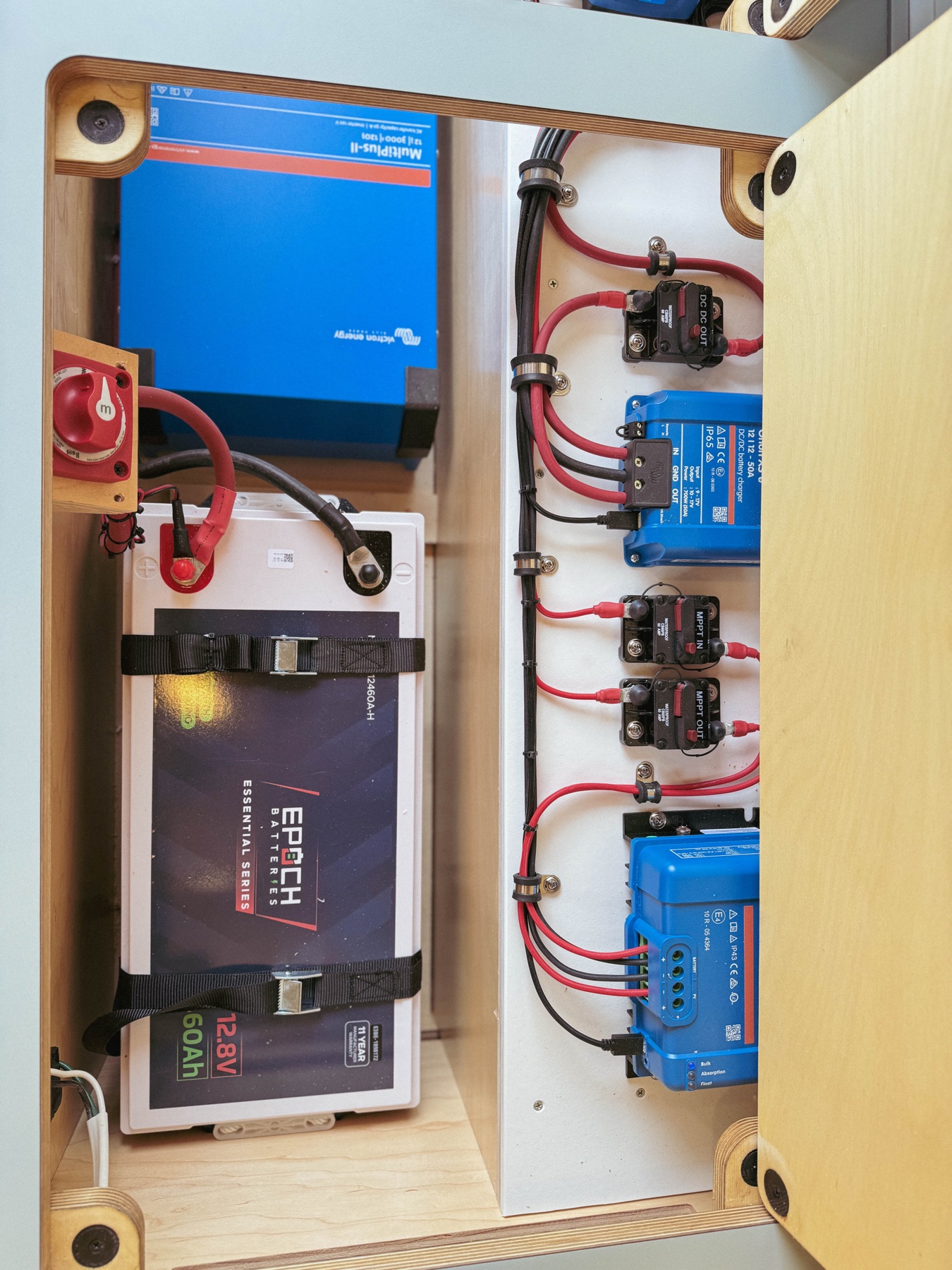
Every Sequoia + Salt power system is built on Victron Energy components — the same Victron used by serious sailboats, off-grid homes, and premium custom builders worldwide. Every battery is 12V LiFePO4 lithium. No AGM, ever.
Three power tiers — tap any tier for full specs:
The Expedition system runs the AC off-grid for 47 hours — nearly two days without plugging in or starting a generator. The same use case on a Winnebago Revel is 3–4 hours. On a typical Tier 1 Class B with AGM and 110V AC, it's less than an hour before you're starting an Onan generator.
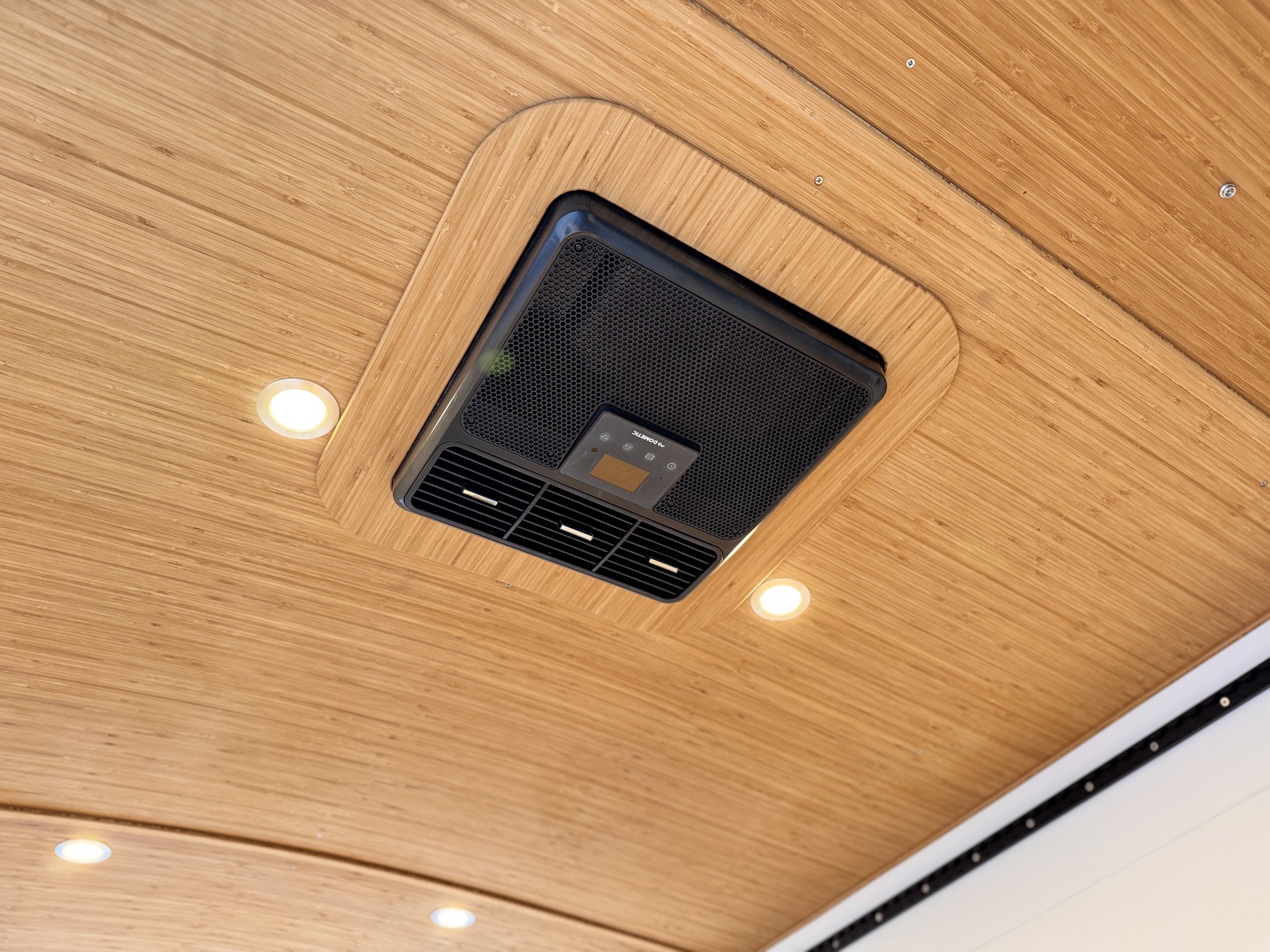
Why the difference? We use a 12V DC air conditioner, not a 110V residential unit. Mainstream Class Bs use the same residential AC you'd find in a house, then invert their battery's 12V DC up to 110V AC just to power it — losing 10–15% of capacity on every inversion. Our 12V AC pulls directly from the battery. No inversion losses, no efficiency penalty.
Lithium vs AGM matters too. AGM batteries deliver only ~50% usable capacity before lifespan suffers; lithium delivers ~90%. Most mainstream Tier 1 Class Bs (Travato, Solis, Galleria, Nova, Tellaro, Sequence) still ship AGM as standard. Lithium is an upgrade you pay extra for.
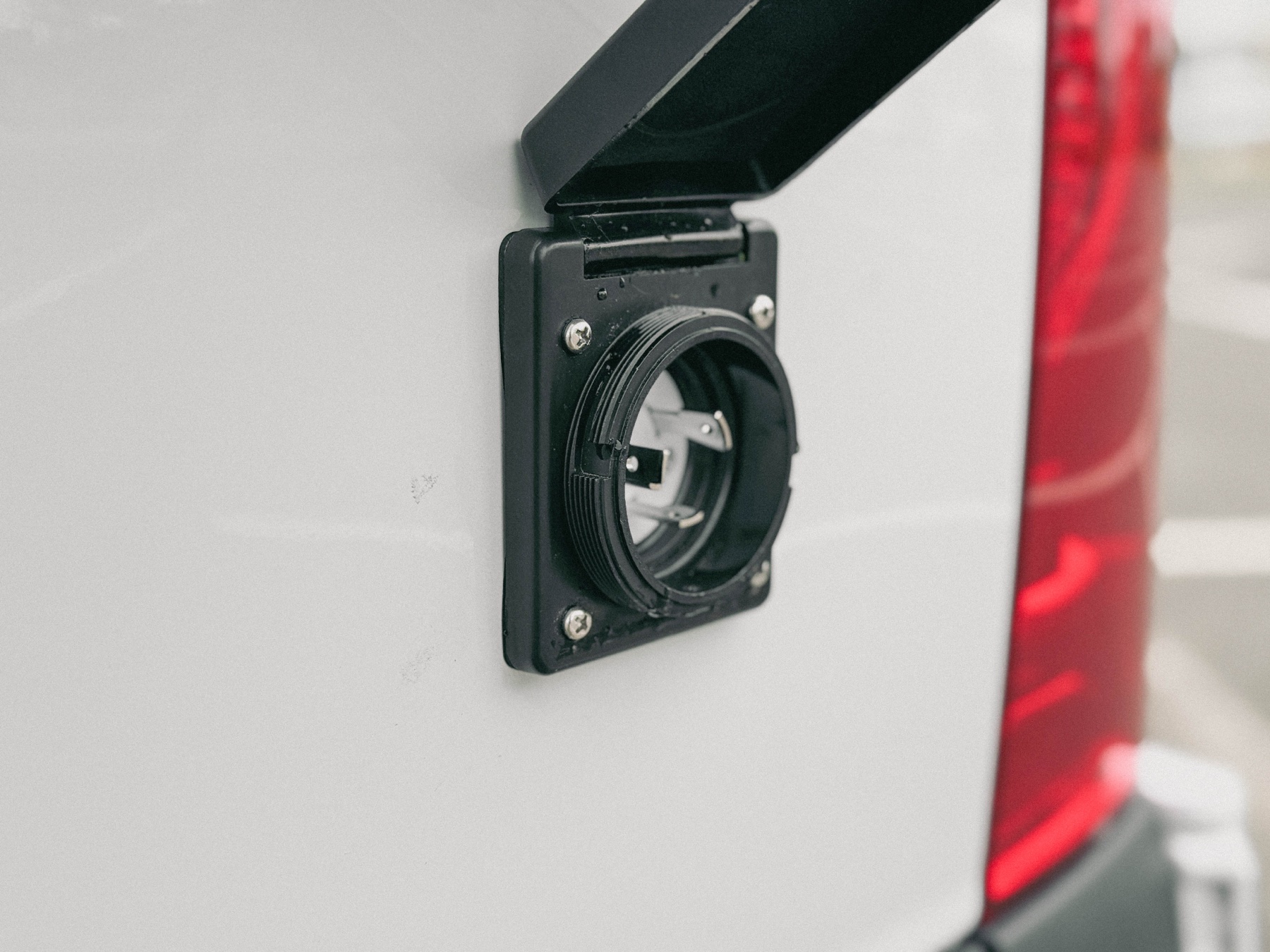
And because everything is Victron, service is available anywhere. Any qualified RV shop, marine shop, or off-grid solar installer in North America can service it. Victron techs can even diagnose your system remotely via cell signal. Compare that to a Revel's proprietary EcoFlow system or Storyteller's integrated Lithionics packaging — when those fail, the dealer network gets narrow fast.
Our vans are true four-season builds. Full thermal envelope insulation — walls, ceiling, floor, door cavities — using closed-cell foam plus thermal break. R-value comparable to a well-built home wall, packed into a van shell.
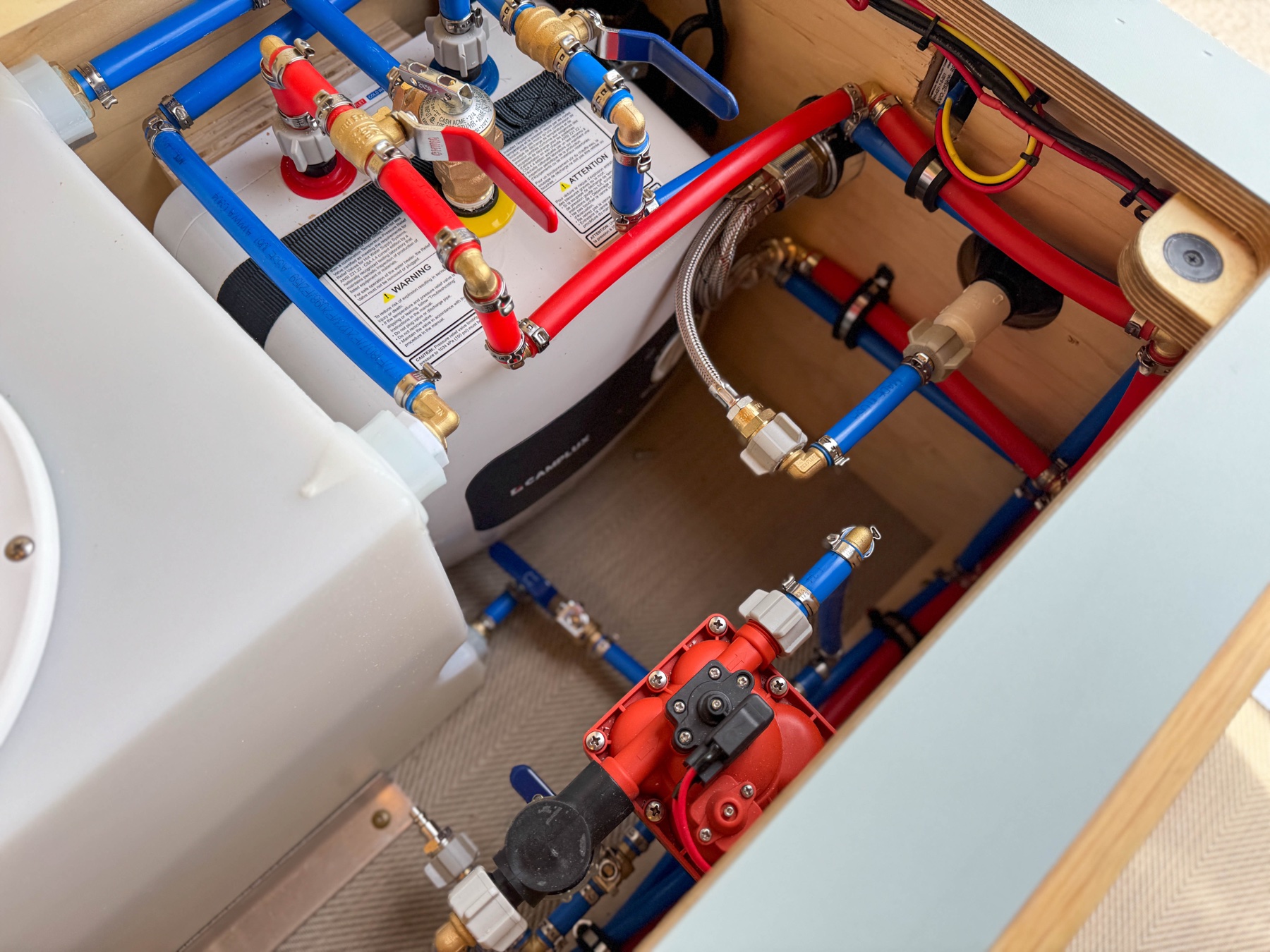
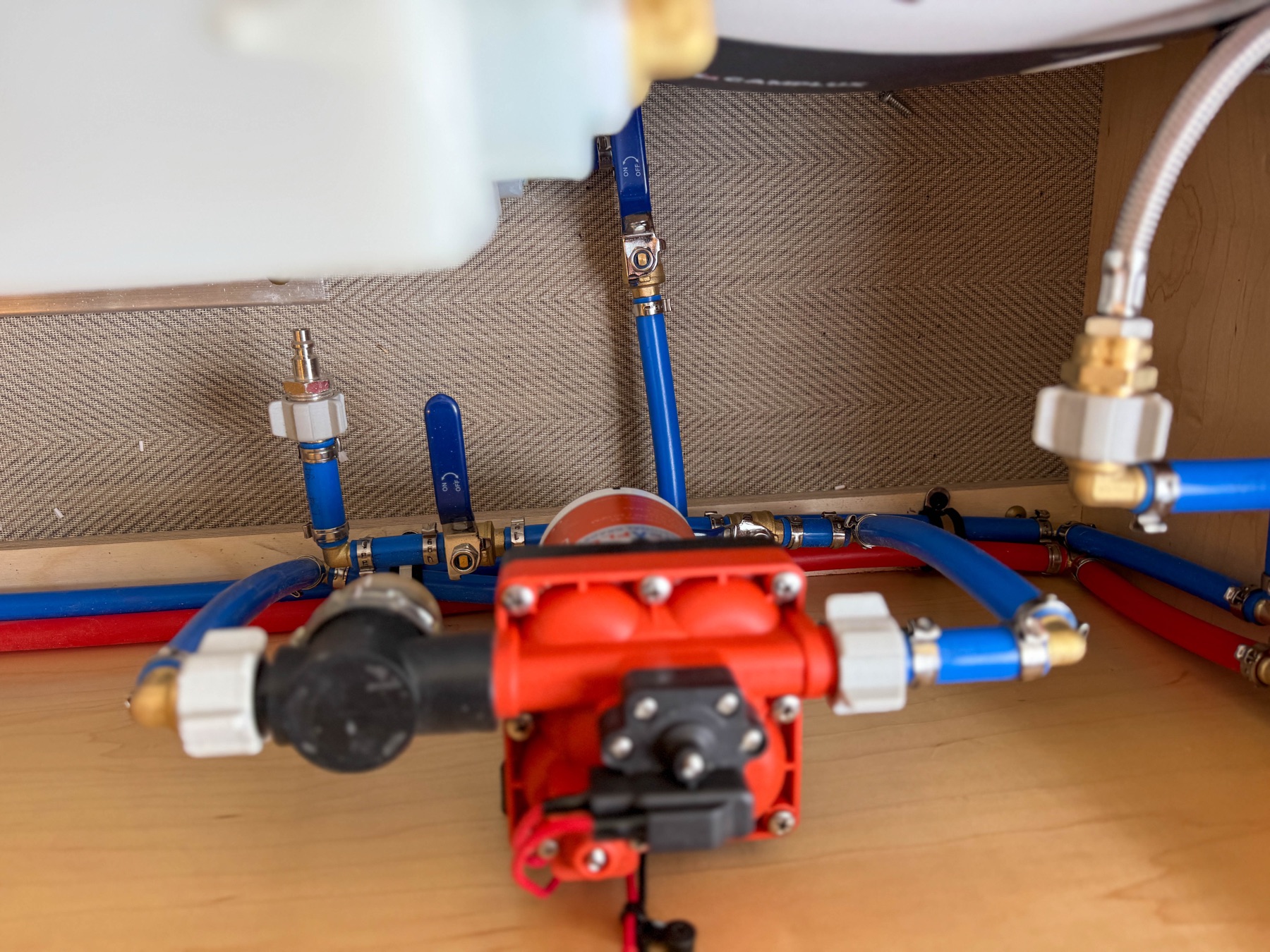
All plumbing runs inside the insulated cabin. No heated water lines, because we don't need them — the lines never leave the heated envelope. Nothing freezes on your trip because nothing is exposed to freezing air in the first place. Simpler and more reliable than running heat-traced lines underneath where they can still fail.
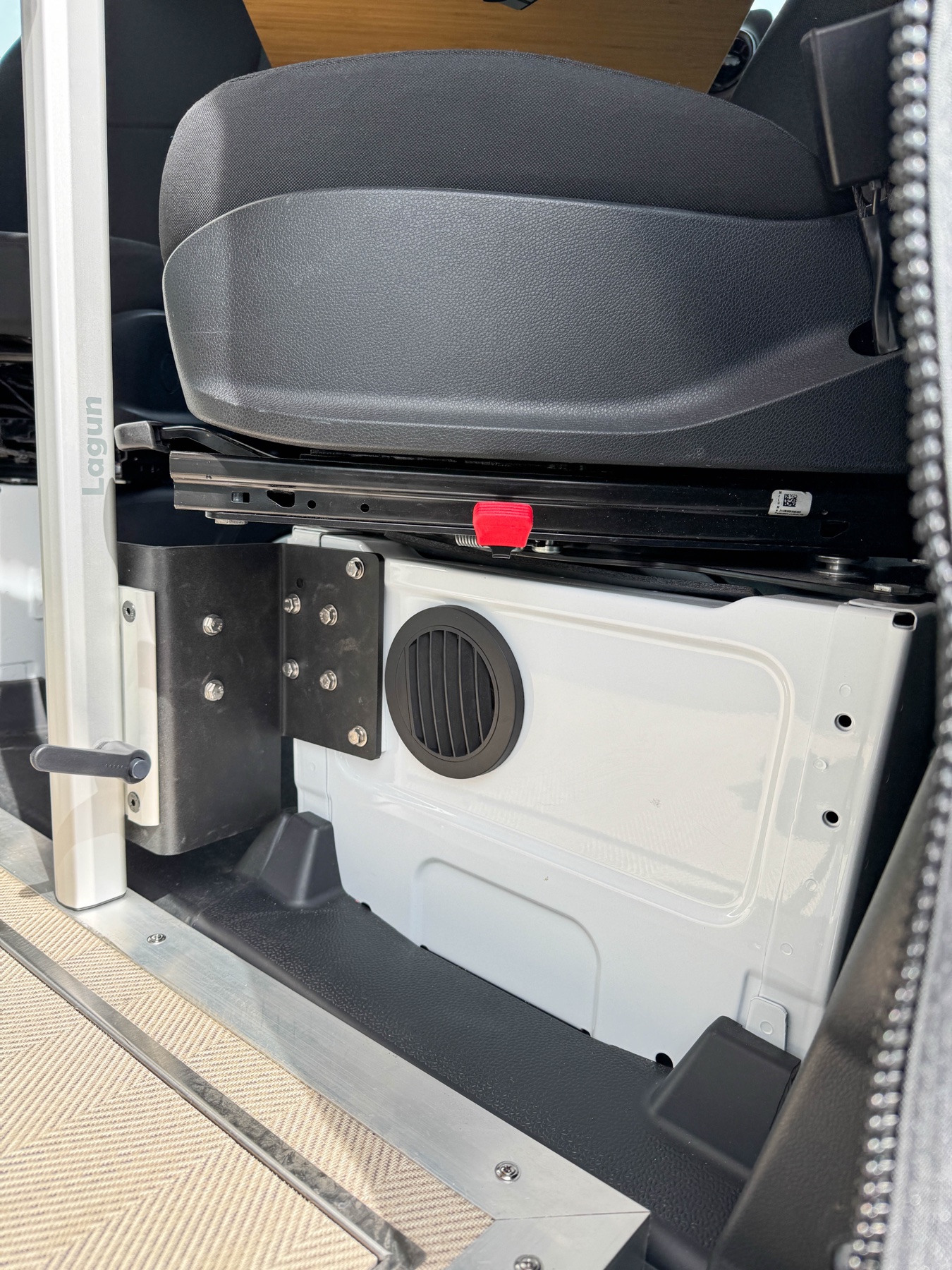
Our heat taps directly into the vehicle's diesel fuel system. The single most efficient way to heat a van. The fuel is already onboard, already being carried for the drivetrain. The heater (Webasto or Espar) pulls a small amount from the chassis tank, runs at any altitude, and doesn't depend on any secondary fuel.
We do not use propane. Period. Most mainstream Class B brands run their heat, hot water, and cooking on propane — meaning a pressurized flammable fuel stored inside or under your van that has to be refilled at specific stops. We don't believe in that. Propane shouldn't, in our view, be stored and driven around with you.
The result: heat already fueled when you drive away. No tank refills. No safety concerns. Most mainstream Tier 1 Class Bs are three-season builds with propane heat — they handle a 35°F night, but struggle below 20°F, and ask you to live with a propane tank.
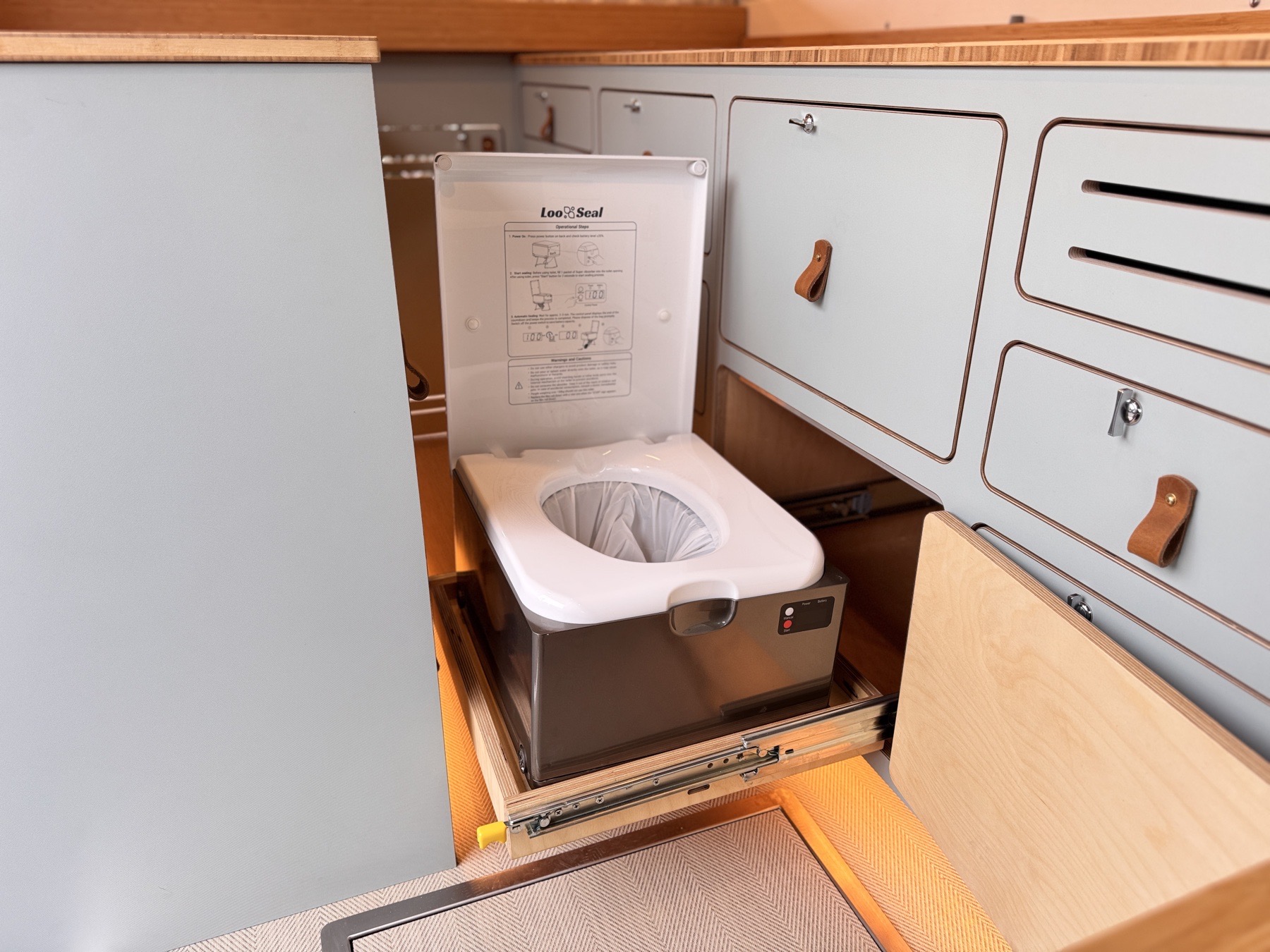
Mainstream Class B toilets connect to a black water tank that must be fully winterized in cold weather — meaning no winter bathroom use without risking damage to the system.
Our waterless heat-sealed toilet works year-round. Each use heat-seals the bag immediately, on the spot. The seal is complete. No off-gassing for up to 30 days. Two things our customers love most:
If this sounds unconventional — it might be. But using a bathroom inside a camper is inherently unconventional. It's not a house. It's a camper. The waste has to go somewhere. We chose a system that's odorless, year-round usable, and doesn't put the dump-station job on one person. If it sounds gross, the honest answer is: don't go to the bathroom in your camper. Use a campground bathroom or a gas station. That's a legitimate choice.
Power technology is moving fast. Six years ago, AGM was standard and the largest battery you could fit was 200Ah at 150 pounds. Today, lithium offers 460Ah in the same physical case — more than double the capacity, less than half the weight.
Solar followed the same curve: six years ago, 200W max on a Sprinter roof. Today, 400W in the same footprint. Inverters went from on/off switches to digital displays, Bluetooth control, and remote diagnostics via cell signal — a Victron technician can log into your system from anywhere in the country to troubleshoot without you visiting a service center.
We design every Sequoia + Salt to be upgradeable. Wire runs sized larger than current systems need. Bus bars built for expansion. Battery compartments sized for future upgrades. Roof rack structured for additional solar.
You might save today on a cheaply built camper. But when it's time to upgrade — and it will be — you'll find that no one is willing to do the job. And if they are, the cost won't be worth what your cheaply built camper is worth at that point. Invest in builders who understand where the technology is going.
How Builds Work
We're a semi-custom and fully custom builder. Our proven platforms — The Scout and The Loft — are productized layouts you tailor to how you travel.
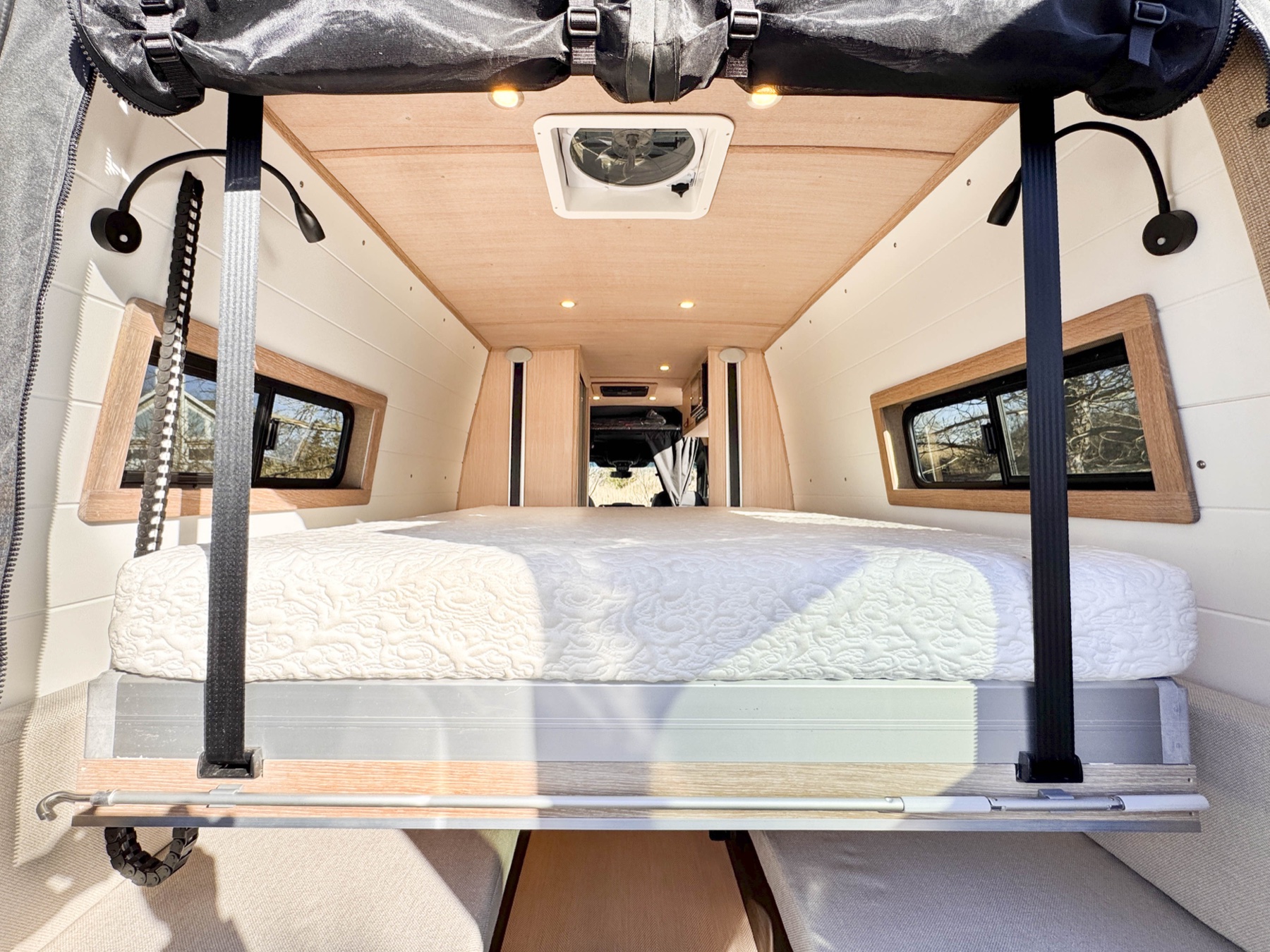
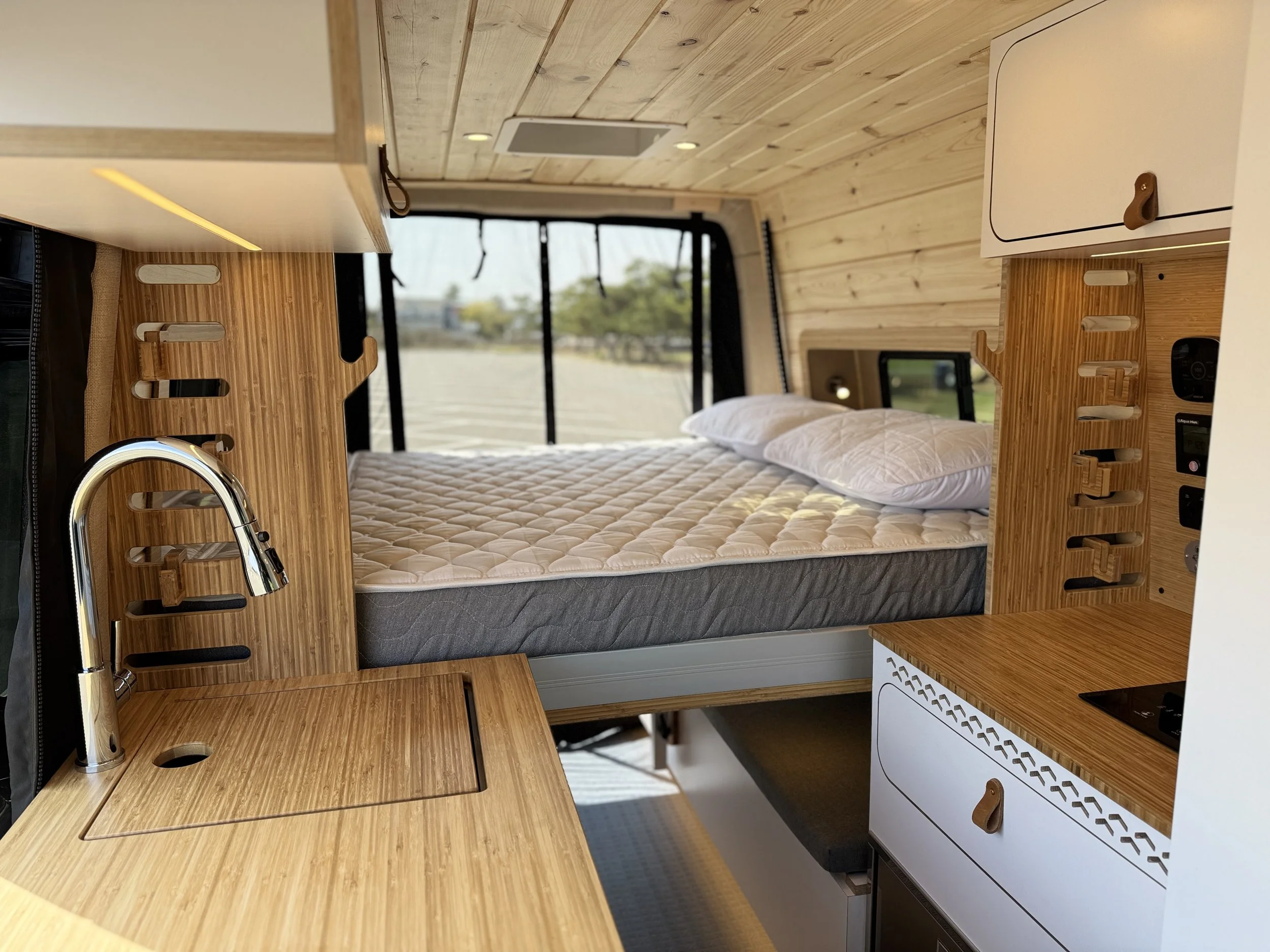
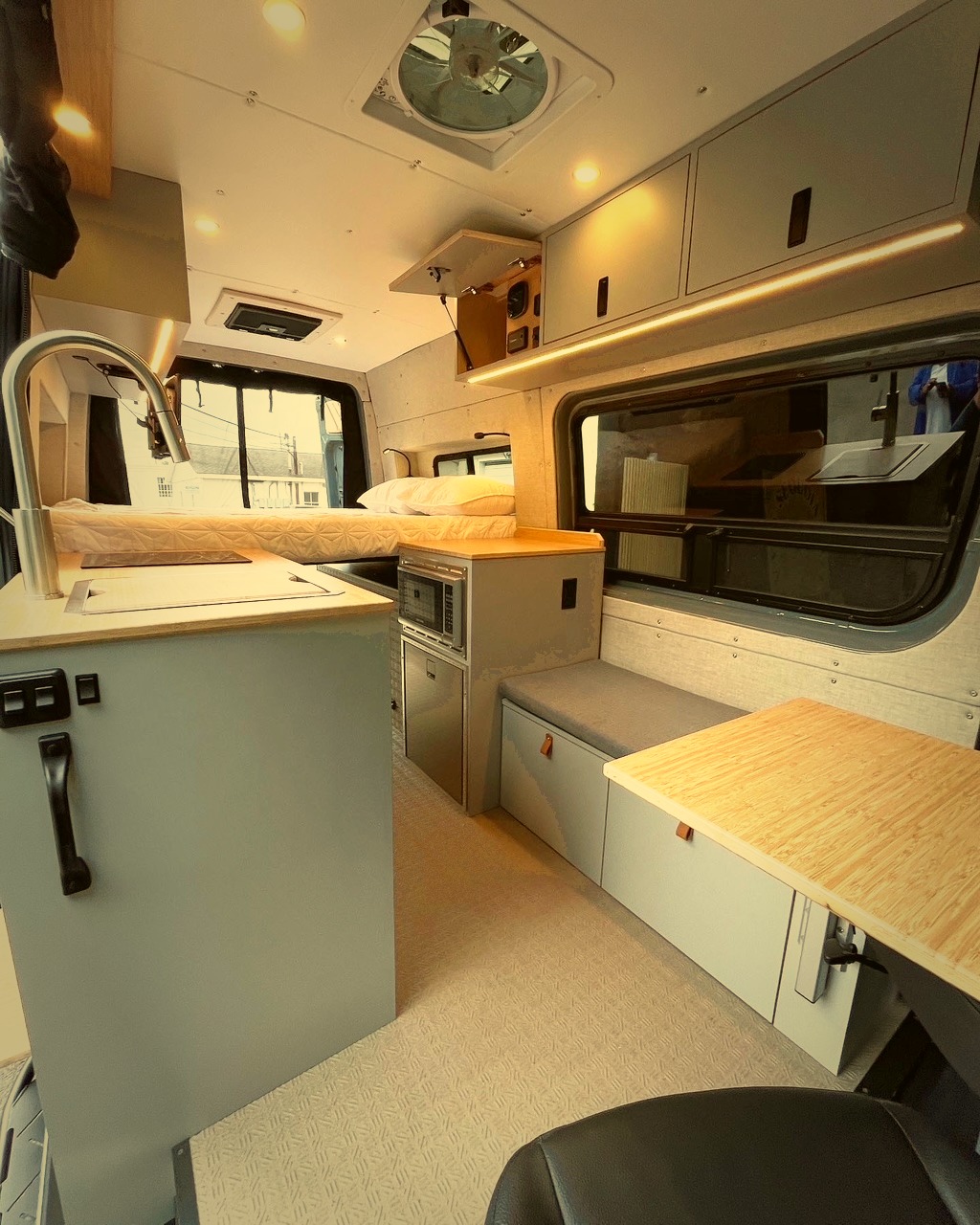
An east-west electric lift bed over a convertible lounge on the Sprinter 144 — sleep up top, live underneath. For travelers who want the most maneuverable van: the 144 parks and drives like a daily, the bed is always ready, and the floor opens into a full lounge by day.
An electric lift bed above a convertible lounge. Maximum living space, day and night. For couples, full-timers, remote workers, and travelers who prioritize daytime living comfort. The lift bed disappears overhead during the day, opening into the most spacious lounge in its class.
Chassis (Sprinter AWD/RWD, Transit AWD/RWD, ProMaster FWD), wheelbase length, power system tier, climate system, bath configuration, bed orientation, pop-up tent option, 90 standard laminates + 103 premium laminates (193 swatches total), ~100 upholstery options, 20 cabinet hardware options, and multiple cabinet foundation variations.
The result: two customers ordering "The Loft" can end up with two genuinely different-looking vans — same productized platform, completely different finished products.
Semi-custom means the speed and reliability of a proven platform with the design flexibility of a custom build. Most fully-custom shops have 12–36 month wait lists. Production builders give you almost no choice. We deliver in 4–6 months with hundreds of choices on the table.
Fully Custom is available for buyers who want bespoke cabinetry, an original layout, or unique structural elements. The build takes 4–8 months and costs more due to additional engineering and design time. For most customers, semi-custom gets you 95% of what fully custom would, in less time, for less money.
Not sure where to start?
See the floorplans we've already built, then make one yours.
Real 2026 Pricing
Mainstream brand pricing includes the cost of the van itself. Our conversion pricing does not. To compare apples-to-apples, add the chassis MSRP:
Not theoretical minimums — what most customers actually spend:
Tap any brand for its 2026 MSRP range:
2026 MSRP: $261K–$278K
Dealer MAP: $188K–$197K depending on incentives.
2026 MSRP: $210K–$270K typical.
2026 MSRP: $235K–$246K. Off-road-oriented trim.
2026 MSRP: ~$247K.
2026 MSRP: $299K–$307K.
2026 MSRP: ~$299K.
2026 MSRP: $215K–$250K.
The price overlap is significant. What differs is what you get for the money — same six-figure investment, but a Sequoia + Salt is built marine-grade with the materials and systems above, while a mainstream Class B is built for the production timeline that maximizes the manufacturer's margin.
Be Honest With Yourself
The Right Fit
You want a four-season expedition van built around how you actually travel. You'd rather wait 4–6 months for the right van than buy what's available on a lot today. You think long-term — the van you buy at 50 should still be the van you love at 65. You care about being serviceable anywhere, not stuck in a dealer queue. You want real materials.
You're a serious adventurer (Scout territory — bikes, boards, climbing, surfing, photo gear) or a serious traveler (Loft territory — couples on long trips, full-timers, remote workers, retirees in the second act). You understand that premium custom means "configured for you, built to last, serviceable for life."
What customers say
We let our customers do the talking. See real, verified reviews from owners of Sequoia + Salt builds and service work — directly on our Google Business Profile.
What to Do Next
FAQ
A 2026 Revel runs $261K–$278K MSRP (with dealer MAP often $188K–$197K depending on incentives). A Sequoia + Salt Loft on a Sprinter AWD chassis with comparable systems and finishes typically lands $225K–$285K all-in for most builds, scaling higher for heavily configured spec. The price ranges overlap. The Revel uses proprietary EcoFlow power and production-grade materials. The Loft uses Victron power and marine-grade construction.
Storyteller MODE in 2026 typically runs $210K–$270K depending on trim. Classic/Dark Mode ~$212K, Tour XL ~$254K, Beast/XO ~$250–270K. We overlap with most of their range. Both are Sprinter-based premium platforms. Storyteller delivers through dealers; we deliver directly. Our edge: marine-grade construction, Victron electrical, four-season build philosophy. Storyteller's edge: brand recognition and dealer availability.
Loosely. The 2026 Interstate 19X (off-road model) runs $235K–$246K MSRP. The 24GT runs $299K–$307K. Airstream carries real heritage — if the badge matters, it's a legitimate reason to buy one. If serviceability, customer-specific design, and 15-year build quality matter more, we're the better fit.
4–6 months for The Scout or The Loft (semi-custom). 4–8 months for Fully Custom builds. For comparison, most premium custom shops run 12–36 months.
Manasquan, New Jersey — about 60 miles south of Manhattan on the Jersey Shore. Shop visits by appointment.
Because we want to make sure the vans we build go to customers who can comfortably afford them. Most of our customers pay cash, use a HELOC, or work with RV-specialty lenders directly. We're happy to recommend lenders.
That's our Fully Custom path. The build takes 4–8 months and costs more because of additional engineering and design time for an original layout. We've built one-off layouts for adaptive needs, gear-specific configurations, and unique geographic requirements. Talk to us.
⚠️ A note on the data. Class B specifications and pricing change frequently. The mainstream brand pricing and specs on this page were sourced directly from manufacturer documentation and current dealer listings at the time of the last update. Always verify current pricing with the brand or dealer before making a buying decision.
Last updated: May 2026. Have a question we didn't answer? Email us at hello@sequoiasaltvans.com.