Buyer’s Guide
I’ve installed just about every type of toilet there is into a van. Here’s the truth about all of them — what works, what stinks (sometimes literally), and what nobody tells you until it’s too late.
The 30-Second Answer
For most people, a heat-seal bag toilet is the best mix of clean, scentless, and easy to live with. If money’s tight and you’re not squeamish, a bucket with a bag genuinely works and costs almost nothing. A cassette toilet is fine if you want that familiar flush-and-tank feel and don’t mind the dump job. There’s no single “best” — you find yours by answering four questions: your budget, your yuck factor, who empties it, and where it physically goes in the van.
First Principles
Here’s the trap almost everyone falls into. You’ve used a toilet every day of your life, so you figure you understand toilets. You don’t — not van toilets.
The toilet in your house is connected to a sewer or a septic tank. You flush, and it’s gone — out of sight, out of mind, forever. A van toilet flips that completely. You carry your waste with you. It lives in a tank, a bag, a cassette, or a bin, inside the same van you’re sleeping in. It’s a lot more like a boat or an off-grid cabin than a house.
And a van has one thing a cabin doesn’t: it bakes in the sun and freezes at night. That temperature swing matters, because heat plus human waste means the one thing nobody puts in the sales photos — off-gassing. Smell. Pressure building in a tank. The stuff you actually have to design around. So the real question was never “which toilet is nicest.” It’s “how do I want to deal with carrying my own waste around?” Once you think about it that way, the choices get a lot clearer.
The Options
The best for most people. You go in a film bag, drop in a coagulant powder that gels liquid and kills smell, and press a button — the unit heat-seals the bag and drops it in a bin, odor-locked up to 30 days. Cleanest and scentless, and everyone deals with their own use right then. Tradeoff: ~$1–2 per flush in consumables. Modiwell/LooSeal (~$1/flush, about half a Wrappon’s price) is where I’d start; Wrappon is the tough established name; Laveo is compact but locks you into pricier proprietary cartridges.
Affordable, proven, a little gross. A built-in unit with a removable holding tank you slide out a side hatch, wheel to a dump station, and empty. Cheap, familiar, few failure points — but the tank gets heavy (~8 lbs a gallon) and can burp built-up gas back at you when you open it. Great if you travel where dump stations are easy to find.
The full RV setup: a toilet plumbed to an under-vehicle black tank, emptied by hose at a dump station, almost always in an enclosed, roof-vented bathroom. Closest to home — but the most infrastructure and the most dump-station dependence, especially off-season. Makes sense in a big four-season motorhome; in a nimble van it’s usually more than you need.
Liquids and solids stay separated — a jug up front for urine, a bin in back with peat or coconut coir for solids. Genuinely good: every shape and size (easy to design around) and no per-use consumables. What I don’t love: the litter-box note, the vinegar urine-jug chore, and in humid climates solids often don’t fully compost before you dump them — I’ve seen growth in the bins. Loved by the tiny-home/DIY crowd; go in eyes open.
Burns waste down to a little sterile ash — no tank to haul, and scentless, which is a big deal. Downsides: runs on propane with about a 30-minute burn cycle per use, and units run well into the thousands. Worth watching: a diesel version expected around 2026–27 that would tap the van’s own fuel — if it lands, this category gets a lot more interesting for vans.
The cheapest there is, and no shame in it: a bucket, a bag liner, maybe some sawdust or litter. If your yuck factor is genuinely low, you can save a ton of money and it just works. It’s the most direct relationship with your own waste you can have — and plenty of people are completely happy with it.
Decision Framework
Forget “what’s the best toilet.” Run your situation through these four questions instead — answer them honestly and the right toilet usually picks itself.
Head to Head
Most people land here trying to settle one specific argument in their head. Here’s the honest short version of each.
Composting vs. Cassette. The cassette is cheaper up front and feels more like a normal flush, but you’re hauling a heavy tank to a dump station and dealing with the off-gas burp. Composting has no tank to dump and no per-use cost, but you’ve got the litter-box smell, the urine jug, and a bulkier unit. Cassette if you want familiar and cheap; composting for dump-station independence.
Bag toilet vs. Composting. The one I get asked most. Bag toilets (Wrappon, Modiwell) win on cleanliness, zero smell, and a more compact body — but you pay roughly a dollar-plus per flush in consumables forever. Composting has no consumable cost but more smell and maintenance. If your budget can handle the per-use cost, I’d take the bag toilet almost every time.
Nature’s Head vs. OGO vs. Air Head. Within composting, the big three. Nature’s Head is the proven workhorse (and the tallest/widest — measure your space). OGO adds an electric churn and a more compact body. Air Head is the marine favorite with a flexible setup. More alike than different — pick on size, churn style, and price.
Wrappon vs. Modiwell vs. Laveo. Within bag toilets: Wrappon is the premium established name, Modiwell/LooSeal does nearly the same job at about half the unit cost and ~$1/flush, and Laveo is standard-height but locks you into pricier proprietary cartridges. For most people I’d price Modiwell against Wrappon first.
From the Build Floor
This is the mistake I see most, and it costs real money: people buy the cheapest toilet to start. Then a year in, they wish they’d gone with a bag toilet — and discover it won’t fit the space they built for the cheap one.
Think about it. A small cassette or a compact composting unit has a certain footprint, so you build the cabinet, the drawer, the nook — all sized to that toilet. Then you spend a season living with the dump job or the litter-box smell, decide you want the clean heat-seal experience everyone raves about… and the bag unit is taller, or wider, and flat-out doesn’t fit the hole you already built. Now you’re not just buying a new toilet — you’re tearing out and rebuilding cabinetry.
So here’s the builder advice worth more than any single toilet: design the space for the toilet you might eventually want, not just the one you’re starting with. Even if you start cheap, build the cavity to fit a bigger unit down the road. It costs you nothing now and saves you a teardown later.
A Quick Word on Size
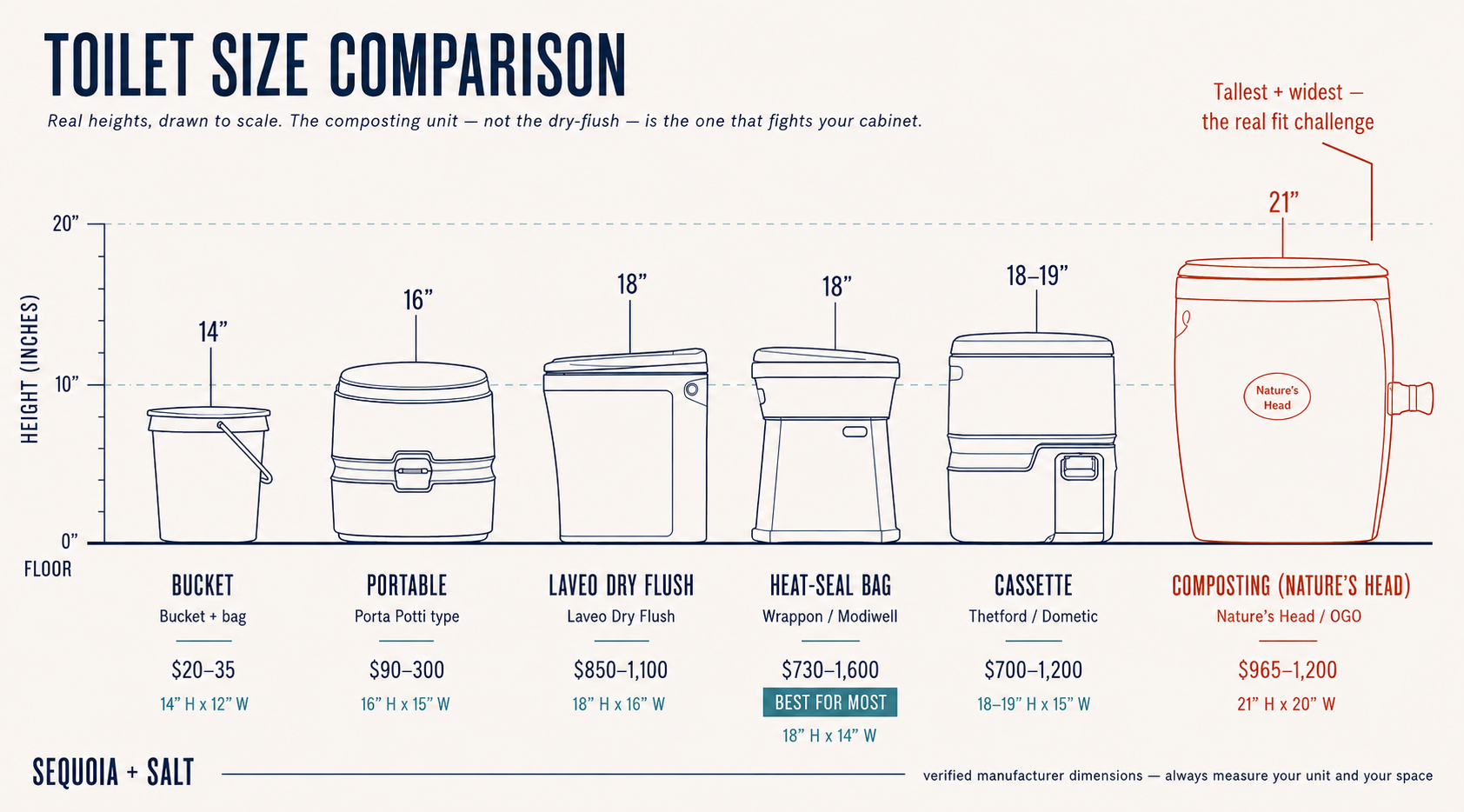
And not in the direction people assume. A compact composting unit like a Nature’s Head is actually one of the tallest and widest options out there — around 20–21″ tall and 19–20″ wide once you count the urine bottle and the handle sticking out the side.
Meanwhile a heat-seal bag unit or a Laveo dry-flush is a fairly compact, standard-height box (roughly 18″ tall). A basic Porta-Potti is the shortest of the real toilets at about 16″. And a bucket is, well, bucket-sized. So before you commit, measure the actual unit — lid open, seat at sitting height, and any handle or bottle that sticks out the side — then measure the space it has to live in. The number of people who buy a composting toilet that “fits the floor” but won’t clear the cabinet above it is higher than you’d think.
The Master Toilet Database
The part most guides skip: an actual, honest list of what’s out there, organized by how people really shop. Prices are typical street prices and move around, so treat them as ballpark.
| Brand | Model | Typical Price |
|---|---|---|
| Thetford | C223-CS | $850–1,000 |
| Thetford | C224-CW | $900–1,050 |
| Thetford | C402C | $900–1,100 |
| Thetford | C403L | $900–1,100 |
| Thetford | C404C | $900–1,100 |
| Dometic | CT3000 | $800–950 |
| Dometic | CT4000 | $900–1,200 |
| Fiamma | Bi-Pot 30 | $130–170 |
| Fiamma | Bi-Pot 39 | $170–220 |
| Brand | Model | Typical Price |
|---|---|---|
| Thetford | Porta Potti 135 | $90–120 |
| Thetford | Porta Potti 365 | $150–180 |
| Thetford | Porta Potti 565E | $220–300 |
| Dometic | 972 | $110–150 |
| Dometic | 976 | $150–220 |
| Camco | Premium Portable | $100–170 |
| SereneLife | Portable Toilet | $90–130 |
| Brand | Model | Typical Price | Cost / Flush |
|---|---|---|---|
| Modiwell | LooSeal / LE-310 EVO | $730–800 | ~$1.00 |
| Modiwell | Elite R1808 (fixed) | $730–850 | ~$1.00 |
| Wrappon | Trekker WT-4 | $1,400–1,600 | ~$1.40 |
| Laveo | Dry Flush | $850–1,100 | ~$1.50–2.00 |
| Clesana | C1 | $1,300–1,600 | ~$1.00–1.50 |
| Brand | Model | Typical Price |
|---|---|---|
| Nature’s Head | Spider Handle | $965–1,050 |
| Nature’s Head | Crank Handle | $965–1,030 |
| Air Head | Marine Composting | $1,100–1,300 |
| OGO | Origin (electric agitator) | $1,000–1,100 |
| OGO | Nomad (portable) | $200–260 |
| Separett | Villa | $950–1,150 |
| Separett | Tiny | $900–1,050 |
| Sun-Mar | Excel | $1,800–2,000 |
| Sun-Mar | Compact | $1,400–1,700 |
| Sun-Mar | GTG | $900–1,100 |
| Trelino | Evo S | $650–850 |
| Trelino | Evo L | $750–900 |
| Trobolo | WandaGO | $180–250 |
| Trobolo | WandaGO Lite | $180–230 |
| Trobolo | SilvaBlœm | $700–900 |
| CompoCloset | Cuddy | $700–950 |
| Kildwick | MiniLoo | $350–500 |
| Kildwick | FancyLoo | $450–700 |
| Boxio | BOXIO Toilet | $180–230 |
| Brand | Model | Typical Price |
|---|---|---|
| Cinderella | Travel | $3,300–3,700 |
| Cinderella | Comfort | $4,800–6,500 |
| Cinderella | Freedom | $4,500–6,000 |
| Incinolet | Electric | $2,000–2,500 |
| EcoJohn | TinyJohn | $3,500–4,500 |
| Brand | Model | Typical Price |
|---|---|---|
| Jabsco | Twist ’n’ Lock | $220–320 |
| Jabsco | Compact Manual | $180–260 |
| Raritan | PH II | $450–650 |
| Johnson Pump | AquaT Manual | $220–300 |
| Dometic | MasterFlush Manual | $500–800 |
| Brand | Model | Typical Price |
|---|---|---|
| Jabsco | Quiet Flush | $700–1,000 |
| Raritan | Elegance | $1,200–1,800 |
| Raritan | Atlantes Freedom | $1,700–2,500 |
| Dometic | MasterFlush 8700 | $900–1,400 |
| Tecma | Nano | $1,200–1,800 |
| Tecma | Silence Plus | $1,400–2,200 |
| Sanimarin | Maxlite | $1,000–1,600 |
| Brand | Model | Typical Price |
|---|---|---|
| Dometic | VacuFlush 5000 | $1,200–1,700 |
| Dometic | VacuFlush 4800 | $1,500–2,000 |
| Sealand | Traveler Series | $1,300–2,000 |
| Brand | Model | Typical Price |
|---|---|---|
| Thetford | Aqua-Magic VI | $130–200 |
| Thetford | Style II / Style Plus | $200–350 |
| Dometic | 300 / 310 / 320 | $130–280 |
| Dometic | 320 Series | $250–350 |
| Brand | Model | Typical Price |
|---|---|---|
| Reliance | Luggable Loo | $20–35 |
| Reliance | Hassock | $30–50 |
| Cleanwaste | GO Anywhere | $80–120 |
| Kampa | Khazi | $30–60 |
Prices are typical street prices as of 2026 and shift over time — always confirm current pricing with the seller.
What It Costs to Build One In
If you’re just setting a portable unit on the floor, the cost is whatever the toilet costs — done. Where it gets involved is integration: hiding it in a drawer, building it into a shower, venting it through the roof, or wiring it for 12V power. That’s cabinetry and labor, not just the unit.
For what it’s worth: we’ll integrate any toilet on this list into a build — slid into a cabinet, tucked under a counter, built into a shower, vented and wired if it needs it. Doing it so it disappears into the van and still works right is where the build work goes. If you’re trying to figure out which option fits your van and how it should be installed, that’s exactly the kind of thing we work through on every build — happy to talk it through.
Campervan Toilet FAQ
For most people, a heat-seal bag toilet (Wrappon, Modiwell, or LooSeal) is the best balance of clean, scentless, and easy to live with. If your budget’s tight and you’re not squeamish, a simple bucket-with-bag genuinely works. A cassette toilet is a solid middle option if you want a familiar flush and don’t mind the dump job.
Anywhere from about $20 for a bucket to $6,000+ for an incinerating toilet. Most van owners land between $150 (a portable Porta-Potti) and $1,200 (a composting or heat-seal unit). Heat-seal bag toilets also have a per-use cost of roughly $1–2 per flush in consumables; composting and bucket toilets have little to no per-use cost.
When they’re working right, a composting toilet has a mild earthy smell, not a sewage smell — because separating urine from solids is what prevents the off-gassing. But in practice many people notice a litter-box note from the medium, and in humid climates the solids can fail to fully compost before you dump them. Honest answer: less than you’d fear, more than the marketing claims.
No. Bucket, portable, composting, and heat-seal bag toilets are all self-contained and need no black tank or plumbing. Only built-in cassette toilets and full RV-style toilets involve a tank — and even a cassette’s tank is a removable cartridge, not an under-vehicle black tank.
A heat-seal bag toilet. Each use is sealed in an odor-locked bag the moment you press the button, so there’s no shared tank to empty and whoever uses it handles their own waste right then. It’s the most hands-off, lowest-disgust option.
Cassette is cheaper up front and more familiar, but you haul a heavy tank to dump stations. Composting frees you from dump stations and per-use cost, but adds smell, maintenance, and a bulkier unit. Choose cassette for cheap and familiar, composting for dump-station independence.
It depends entirely on the type and how many people use it. A bag toilet’s sealed bags can sit up to 30 days with no smell. A composting solids bin typically lasts 60–80 uses. A cassette or portable tank usually needs emptying every few days of regular use.
There’s no perfect van toilet — there’s the one that fits your budget, your tolerance, how often you’ll use it, and the space you’ve got. That’s exactly the kind of thing we work through on every van we put together. Happy to talk it through.
